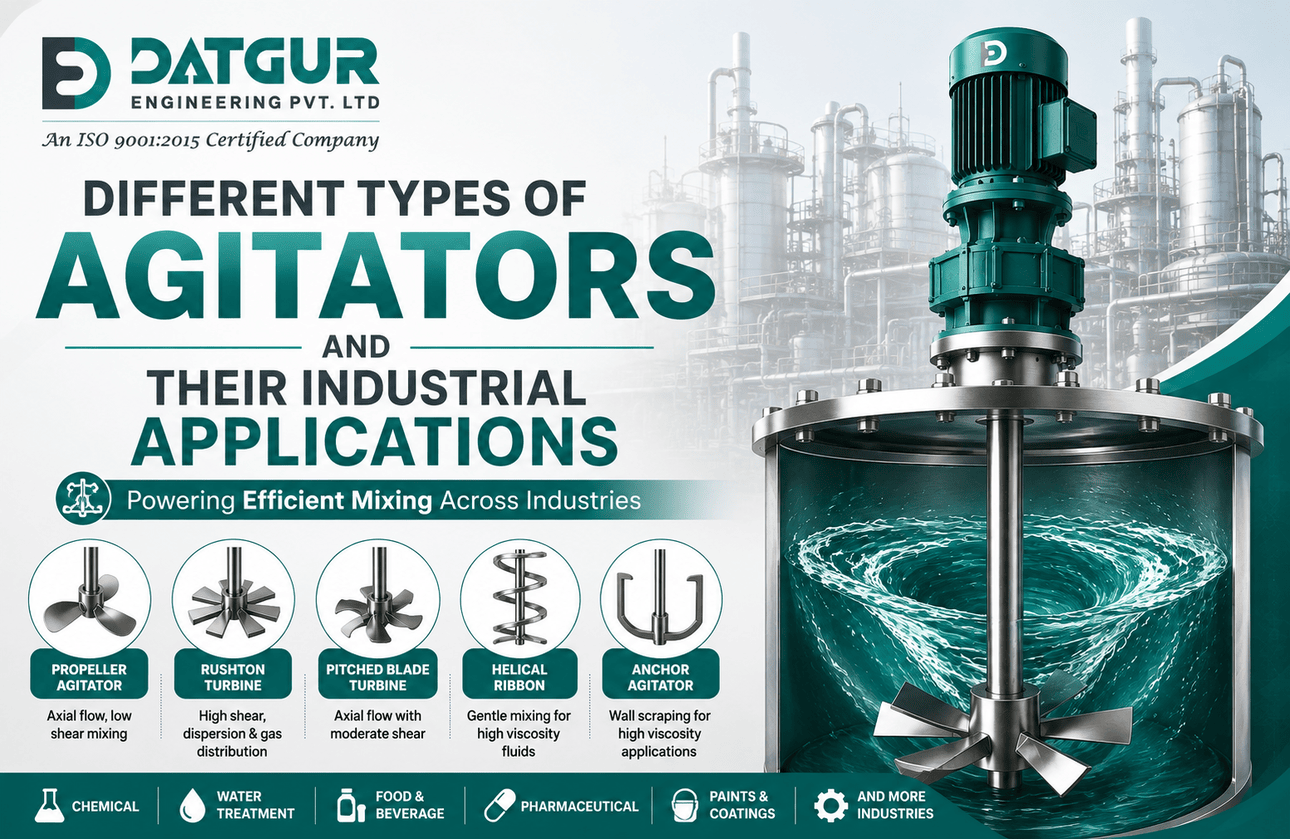
Imagine producing thousands of liters of chemicals, pharmaceuticals, paints, or food products every day, only to discover that inconsistent mixing has compromised product quality. In manufacturing, even the most advanced production systems can fail without efficient mixing technology. This is where industrial agitators become indispensable.
Agitators are designed to create controlled movement within liquids, slurries, and viscous materials, ensuring uniform composition, improved heat transfer, and optimized chemical reactions. From simple liquid blending to handling highly viscous products, different agitator designs serve different process requirements.
Selecting the right agitator not only enhances productivity and product consistency but also reduces energy consumption and operational costs. In this guide, we explore the various types of industrial agitators and their applications across modern manufacturing industries.
What Is an Industrial Agitator?
An industrial agitator is motor-driven mixing equipment used to create movement within liquids, slurries, or semi-solid materials. By transferring mechanical energy through an impeller and shaft assembly, agitators ensure uniform mixing, improve heat transfer, prevent sedimentation, and support chemical reactions. They are widely used in chemical processing, pharmaceuticals, food manufacturing, wastewater treatment, petrochemicals, paints, and mining industries.
Why Choosing the Right Agitator Matters
The selection of an agitator depends on several process parameters, including:
- Fluid viscosity
- Tank size and geometry
- Mixing objective
- Temperature requirements
- Presence of solids or gases
- Desired shear rate
An improperly selected agitator can result in poor mixing, increased operating costs, inconsistent product quality, and frequent maintenance issues.
Different Types of Agitators and Their Applications
Different agitator designs are engineered to meet specific industrial mixing requirements.
1. Propeller Agitators
Propeller agitators feature marine-style blades that rotate at high speed to generate strong axial flow. They are highly effective for low-viscosity liquids and applications requiring rapid circulation.
Key Features:
- High-speed operation
- Excellent liquid circulation
- Low power consumption
- Suitable for low-viscosity fluids
Industrial Applications:
- Beverage production
- Water treatment plants
- Solvent mixing
- Chemical dilution systems
- Pharmaceutical solutions
Propeller agitators are commonly used where fast blending and efficient circulation are required.
2. Turbine Agitators
Turbine agitators consist of multiple blades mounted around a central shaft. They create both axial and radial flow patterns, making them suitable for medium- to high-intensity mixing operations.
Key Features:
- High mixing efficiency
- Effective gas dispersion
- Suitable for liquid-solid and liquid-gas mixing
- Good shear generation
Industrial Applications:
- Chemical reactors
- Fermentation tanks
- Pharmaceutical manufacturing
- Petrochemical processing
- Emulsion preparation
These agitators are ideal for processes requiring strong mixing and enhanced mass transfer.
3. Paddle Agitators
Paddle agitators use flat blades mounted on a rotating shaft to provide gentle mixing. They operate at lower speeds and are suitable for low to medium viscosity materials.
Key Features:
- Simple construction
- Low shear mixing
- Cost-effective operation
- Uniform blending
Industrial Applications:
- Wastewater treatment
- Chemical blending
- Crystallization processes
- Food processing
- Heat transfer applications
Paddle agitators are often selected when product integrity must be maintained during mixing.
4. Anchor Agitators
Anchor agitators are specially designed for high-viscosity materials. Their blades closely follow the tank wall, preventing material buildup and improving heat transfer efficiency.
Key Features:
- Suitable for viscous fluids
- Wall-scraping action
- Enhanced heat transfer
- Low-speed operation
Industrial Applications:
- Paint manufacturing
- Adhesives production
- Cosmetic creams
- Pharmaceutical ointments
- Food pastes and syrups
Anchor agitators are particularly useful in jacketed vessels where temperature control is critical.
5. Helical Ribbon Agitators
Helical ribbon agitators feature spiral-shaped ribbons that continuously move materials both vertically and horizontally. They are designed for extremely viscous products.
Key Features:
- Excellent bulk movement
- Uniform mixing of thick materials
- Reduced dead zones
- Effective heat transfer
Industrial Applications:
- Polymer processing
- Resins
- Heavy chemicals
- Food dough and pastes
- High-viscosity slurries
These agitators ensure complete mixing even when conventional impellers struggle to circulate the material.
6. Side-Entry Agitators
Unlike conventional top-mounted systems, side-entry agitators are installed through the side wall of large tanks.
Key Features:
- Ideal for large storage tanks
- Lower energy consumption
- Easy maintenance access
- Efficient bulk circulation
Industrial Applications:
- Crude oil storage tanks
- Petrochemical plants
- Biogas facilities
- Large chemical storage vessels
They are widely used to prevent sedimentation and maintain product homogeneity in large-volume tanks.
7. High-Shear Agitators
High-shear agitators are engineered to generate intense turbulence and mechanical shear, enabling rapid particle size reduction and emulsification.
Key Features:
- High-speed operation
- Fine particle dispersion
- Superior emulsification
- Reduced processing time
Industrial Applications:
- Paints and coatings
- Cosmetics
- Specialty chemicals
- Food emulsions
- Pharmaceutical formulations
These agitators are preferred when uniform particle distribution and product stability are critical.
Comparison of Common Industrial Agitators
| Agitator Type | Best For | Viscosity Range | Typical Industries |
| Propeller | Fast liquid mixing | Low | Water treatment, beverages |
| Turbine | Gas dispersion and reactions | Medium | Chemical, pharmaceutical |
| Paddle | Gentle blending | Low to Medium | Food, wastewater |
| Anchor | High-viscosity materials | High | Paints, cosmetics |
| Helical Ribbon | Extremely viscous products | Very High | Polymers, adhesives |
| Side-Entry | Large storage tanks | Low to Medium | Oil & gas, petrochemicals |
| High-Shear | Emulsification and dispersion | Medium | Paints, cosmetics, pharma |
Industries That Depend on Agitators
Industrial agitators are essential across numerous manufacturing sectors:
Chemical Industry
Used for blending chemicals, facilitating reactions, and maintaining uniform temperature distribution.
Pharmaceutical Industry
Supports mixing of syrups, suspensions, creams, and active ingredients while maintaining product consistency.
Food and Beverage Industry
Ensures uniform texture, taste, and ingredient distribution in products such as sauces, dairy products, and beverages.
Water and Wastewater Treatment
Helps in flocculation, chemical dosing, neutralization, and sludge management.
Oil and Gas Industry
Used for crude oil homogenization, additive mixing, and storage tank circulation.
Paints and Coatings Industry
Provides pigment dispersion, emulsification, and viscosity control for high-quality finishes.
Conclusion
Industrial agitators are the backbone of efficient mixing operations in manufacturing facilities. From simple liquid blending to complex chemical reactions and high-viscosity processing, each agitator type is designed to address specific process requirements. Understanding the characteristics of propellers, turbines, paddles, anchors, helical ribbons, side entries, and high-shear agitators helps manufacturers optimize performance, improve product quality, and reduce operational costs.
How Datgur Engineering Helps
At Datgur Engineering, we design and manufacture high-performance industrial agitators tailored to the unique requirements of process industries. Our expertise covers chemical processing, water treatment, pharmaceuticals, food manufacturing, and specialty applications. With customized designs, robust construction, and engineering support, we help industries achieve reliable mixing performance, energy efficiency, and long-term operational success.
Get Expert Assistance
Looking for the right agitator solution for your plant?
Contact us today for expert guidance, custom agitator design, and reliable manufacturing solutions that enhance your production efficiency and process performance.
Frequently Asked Questions
1. What is the main purpose of an industrial agitator?
An industrial agitator is used to mix, blend, suspend, disperse, or homogenize materials inside a tank to achieve uniform product quality and process efficiency.
2. Which agitator is best for high-viscosity materials?
Anchor agitators and helical ribbon agitators are generally preferred for handling high-viscosity products such as adhesives, polymers, creams, and pastes.
3. What is the difference between a propeller agitator and a turbine agitator?
Propeller agitators are designed for low-viscosity liquids and create axial flow, while turbine agitators provide stronger mixing, radial flow, and better gas dispersion.
4. How do I select the right agitator for my application?
Selection depends on fluid viscosity, tank size, mixing objective, temperature requirements, solid content, and desired mixing intensity.
5. Which industries commonly use industrial agitators?
Industries such as chemical processing, pharmaceuticals, food and beverage, wastewater treatment, petrochemicals, paints, and mining extensively use industrial agitators.