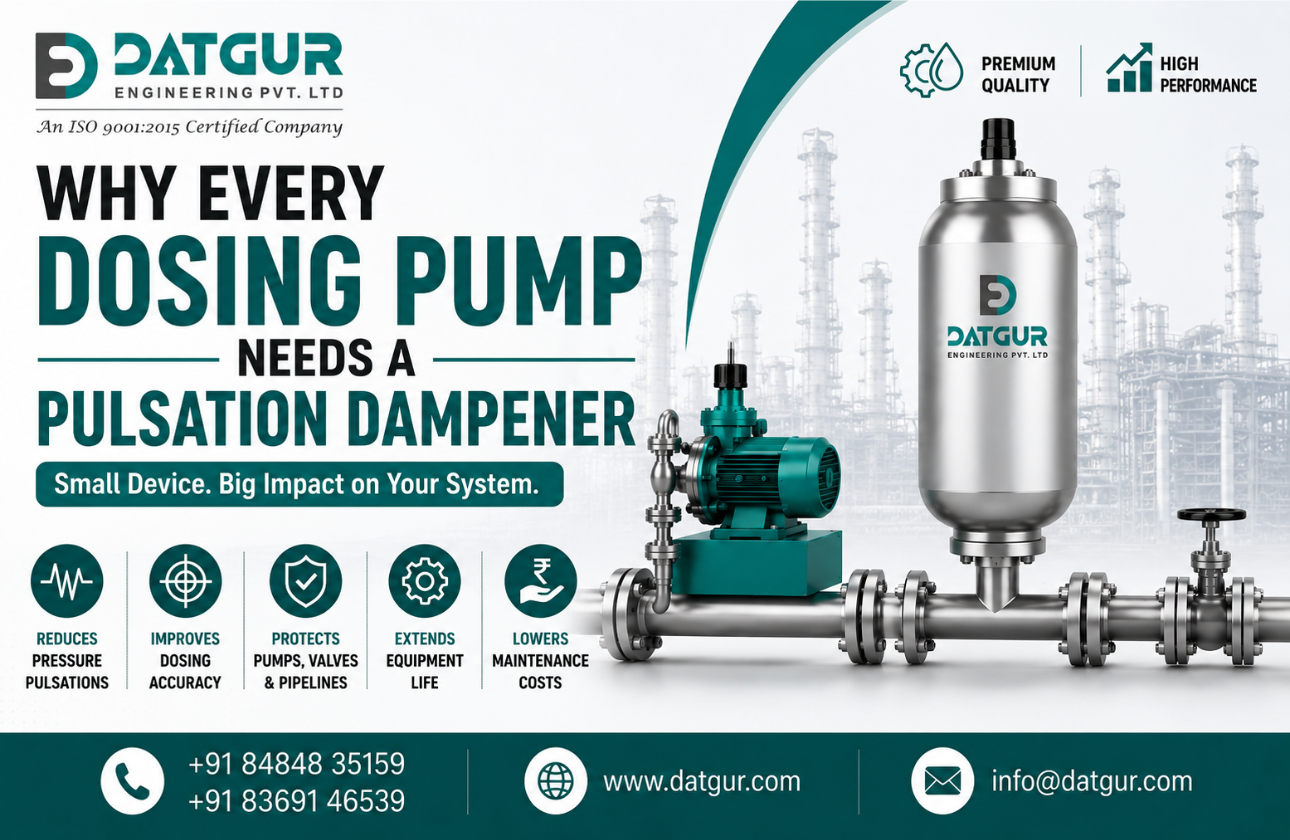
Why Every Dosing Pump System Needs a Pulsation Dampener
A dosing pump is designed to deliver precise quantities of liquid, whether it's a chemical, additive, or treatment solution. While these pumps excel at accuracy, they also create an unavoidable side effect—pressure pulsations. Every stroke of a positive displacement dosing pump generates a surge of pressure followed by a slight drop. Although these fluctuations may seem insignificant, they can gradually affect the performance, reliability, and lifespan of the entire dosing system.
This is where a pulsation dampener becomes one of the most valuable components in a dosing pump installation.
Understanding the Problem Behind Pulsating Flow
Unlike centrifugal pumps that provide a relatively continuous flow, dosing pumps operate by repeatedly filling and discharging a fixed volume of liquid. This reciprocating action naturally produces pulsating flow instead of a smooth stream.
In small systems, these pulsations may go unnoticed initially. However, as operating pressure increases or pipe lengths become longer, pressure fluctuations become more pronounced. Over time, these pressure spikes create stress on pipelines, valves, fittings, pressure gauges, and instrumentation.
The result is not only mechanical wear but also reduced dosing accuracy and increased maintenance requirements.
The Hidden Cost of Ignoring Pressure Pulsations
Many industrial facilities focus on selecting the correct dosing pump while overlooking pressure stabilization. This often leads to recurring operational problems that are mistakenly attributed to the pump itself.
Common issues include:
- Vibrating pipelines
- Fluctuating pressure gauge readings
- Excessive noise during operation
- Leakage from threaded joints and flanges
- Premature valve failures
- Inconsistent chemical dosing
- Frequent maintenance shutdowns
In reality, the pump may be functioning exactly as designed. The real issue lies in the pressure pulses traveling throughout the piping network.
How a Pulsation Dampener Solves the Problem
A pulsation dampener acts as a pressure stabilizer. Installed on the discharge side of the dosing pump, it absorbs the energy created during each pump stroke and releases it gradually between strokes.
Most bladder-type pulsation dampeners use a nitrogen-filled bladder separated from the process fluid. When pressure rises, the bladder compresses. As pressure decreases, the stored energy is released, maintaining a much smoother flow.
Instead of sudden pressure spikes, the pipeline experiences a controlled and nearly continuous flow.
The result is improved hydraulic stability throughout the dosing system.
Better Dosing Accuracy Means Better Process Control
Many industrial processes depend on accurate chemical dosing. Whether controlling pH, disinfecting water, injecting polymers, or adding process chemicals, even small variations can affect product quality and operational efficiency.
Pressure pulsations can cause:
- Uneven chemical injection
- Inconsistent flow rates
- Poor mixing
- Process instability
By smoothing the discharge flow, a pulsation dampener allows the dosing pump to deliver chemicals more consistently. This improves overall process control and reduces chemical wastage.
For industries where precision is critical, such as pharmaceuticals, food processing, water treatment, and chemical manufacturing, this improvement can significantly enhance production quality.
Protecting Expensive Equipment
Pressure spikes do not only affect the pump. Every connected component experiences repeated mechanical stress.
Without a pulsation dampener, excessive pressure fluctuations can damage:
- Pressure transmitters
- Flow meters
- Pressure gauges
- Control valves
- Flexible hoses
- Pipeline supports
- Injection quills
Replacing these components regularly increases maintenance costs and causes unnecessary production downtime.
A properly selected pulsation dampener minimizes these stresses and extends the service life of the entire system.
Reducing Vibration and Noise
One of the easiest ways to identify excessive pulsation is by observing pipeline vibration.
If pipes shake during pump operation or pressure gauges oscillate continuously, pressure pulsation is likely the cause.
These vibrations may seem harmless initially, but continuous cyclic loading weakens pipe supports and mechanical joints over time.
Installing a pulsation dampener significantly reduces vibration levels, resulting in quieter operation and improved system reliability.
Improved Pump Performance
A dosing pump performs best when it operates against stable hydraulic conditions.
Pressure fluctuations can increase the workload on check valves and internal pump components. This may lead to:
- Valve wear
- Reduced volumetric efficiency
- Higher maintenance frequency
- Increased energy consumption
By maintaining a more uniform discharge pressure, the pump operates under smoother conditions, improving both efficiency and reliability.
Applications Across Multiple Industries
Pulsation dampeners are widely used wherever accurate dosing and pressure stability are required.
Typical applications include:
- Water and wastewater treatment plants
- Reverse osmosis systems
- Chemical processing industries
- Paper and pulp manufacturing
- Textile processing
- Food and beverage production
- Pharmaceutical manufacturing
- Power plants
- Fertilizer and agrochemical industries
- Mining and mineral processing
In each of these industries, pressure stability directly contributes to safer operation and improved production efficiency.
Selecting the Right Pulsation Dampener
Simply installing any dampener is not enough.
The correct selection depends on several operating parameters, including:
- Pump capacity
- Flow rate
- Operating pressure
- Chemical compatibility
- Temperature
- Pipe diameter
- Required pulsation reduction
An undersized dampener may provide minimal improvement, while an oversized unit can increase costs without delivering additional performance benefits.
Proper sizing ensures maximum efficiency and long-term reliability.
A Small Investment with Long-Term Benefits
Compared to the overall cost of an industrial dosing system, a pulsation dampener represents a relatively small investment. Yet its impact extends across the entire operation.
Benefits include:
- Smoother flow
- Higher dosing accuracy
- Reduced pressure surges
- Lower maintenance costs
- Longer equipment life
- Reduced vibration
- Improved process stability
- Enhanced operational safety
These advantages often translate into measurable savings through fewer equipment failures, lower maintenance expenses, and improved production consistency.
In many installations, a dosing pump without a pulsation dampener is similar to driving a vehicle without shock absorbers. The machine will continue to operate, but every component will experience unnecessary stress with each cycle. By absorbing these hydraulic shocks before they travel through the system, a pulsation dampener transforms the performance of the entire dosing setup—making it smoother, more reliable, and far more efficient over the long term.