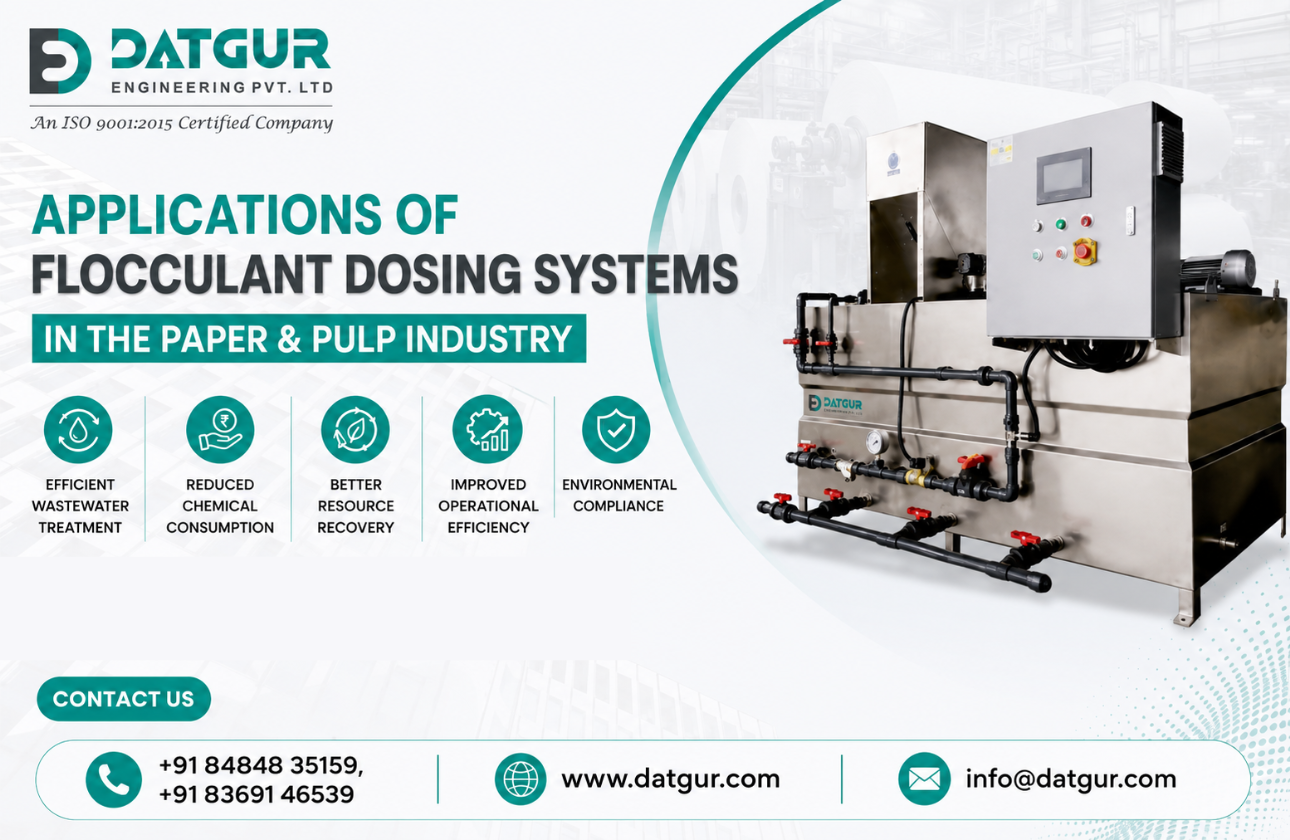
Applications of Flocculant Dosing Systems in the Paper & Pulp Industry
The paper and pulp industry depends heavily on water. Whether it's transporting pulp, washing fibers, bleaching, or producing the final sheet of paper, water is involved at almost every stage of the manufacturing process. The challenge begins once that water leaves the production line. It carries fine fibers, fillers, dissolved organic matter, inks, coatings, and several process chemicals that cannot be discharged without proper treatment.
For plant operators, wastewater treatment isn't simply about complying with environmental regulations. It's also about recovering valuable materials, controlling operating costs, reducing freshwater consumption, and ensuring smooth plant operations. Even small improvements in treatment efficiency can result in noticeable savings over time.
This is exactly why Flocculant Dosing Systems have become an essential part of modern paper mills. Instead of relying on manual chemical addition—which often leads to inconsistent results—automated dosing systems prepare and inject the correct amount of polymer at precisely the right concentration. The outcome is a more stable treatment process, improved separation efficiency, and lower chemical consumption.
Why Wastewater Treatment Is Challenging in Paper Mills
Unlike municipal wastewater, paper mill effluent changes continuously. The quality of wastewater depends on the type of paper being produced, the raw material being used, production volume, and the chemicals involved in manufacturing.
A typical paper mill wastewater stream may contain:
- Fine cellulose fibers
- Clay and calcium carbonate fillers
- Starch
- Printing inks
- Organic contaminants
- Suspended solids
- Process chemicals
Many of these particles are so small that they remain suspended in water for long periods. Without proper coagulation and flocculation, conventional settling tanks cannot remove them efficiently.
This is where Flocculant Dosing Systems make a measurable difference.
How Flocculant Dosing Systems Work
A flocculant is a polymer that causes tiny suspended particles to stick together, forming larger particles known as flocs. These larger flocs settle much faster than individual particles, making clarification significantly more effective.
An automated Flocculant Dosing System prepares the polymer solution at the correct concentration, mixes it thoroughly, allows sufficient maturation time, and doses it continuously into the treatment process. Because every stage is controlled automatically, the system maintains consistent chemical quality throughout the operation.
This consistency becomes especially important in paper mills, where wastewater characteristics can change throughout the day.
1. Improving Wastewater Clarification
One of the first places where Flocculant Dosing Systems demonstrate their value is in primary clarification.
Paper mill wastewater often appears cloudy because countless microscopic fiber particles remain suspended in the water. These particles are too light to settle naturally. When the correct polymer is introduced, they combine into heavier flocs that settle rapidly inside the clarifier.
For operators, this means cleaner overflow water, reduced suspended solids, and improved efficiency throughout the treatment plant.
It also reduces the workload on downstream filtration equipment, helping extend equipment life while lowering maintenance requirements.
2. Recovering Valuable Paper Fibers
Many people view wastewater simply as waste, but in paper manufacturing, wastewater often contains recoverable raw material.
Fine cellulose fibers that escape during production still have value. Allowing them to leave the process increases both material losses and production costs.
With properly designed Flocculant Dosing Systems, these fibers can be aggregated, separated, and recovered before the water reaches the final treatment stage.
Many mills successfully return recovered fibers to production, reducing raw material consumption while improving overall plant efficiency.
3. Enhancing Sludge Dewatering
Sludge handling is one of the most expensive sections of any wastewater treatment plant.
Poor sludge conditioning increases disposal costs because excess water remains trapped inside the sludge. Transporting wet sludge means paying to move water instead of solids.
Accurate polymer dosing improves sludge conditioning by producing stronger flocs that release water more efficiently during mechanical dewatering.
The result is:
- Higher dry solids content
- Lower sludge disposal costs
- Faster dewatering cycles
- Improved performance of filter presses and centrifuges
Even a modest reduction in sludge moisture can translate into substantial annual savings for large paper manufacturing facilities.
4. Increasing DAF System Performance
Many paper mills use Dissolved Air Flotation (DAF) systems as part of their wastewater treatment process.
The performance of a DAF unit depends heavily on floc quality. Weak or poorly formed flocs often break apart before they reach the flotation chamber, reducing separation efficiency.
A properly configured Flocculant Dosing System consistently prepares and doses polymer solutions, producing stable flocs that float more effectively.
This leads to better removal of suspended solids, lower chemical usage, and improved treatment reliability.
5. Supporting Water Recycling Initiatives
Water availability has become an increasing concern for industries worldwide, including paper manufacturing.
Many modern mills are investing in water recycling systems to reduce freshwater consumption and lower operational costs. However, recycled water can only be reused when treatment quality remains consistently high.
Automated Flocculant Dosing Systems help maintain that consistency.
By improving clarification and reducing suspended solids, these systems make treated water suitable for reuse in several manufacturing processes. Besides reducing freshwater demand, water recycling also helps companies meet sustainability goals and comply with stricter environmental regulations.
Why Automation Outperforms Manual Dosing
Some facilities still rely on manual preparation and dosing of polymers. While this approach may appear economical initially, it often creates inconsistent chemical concentrations and fluctuating treatment performance.
Automated Flocculant Dosing Systems eliminate these variables.
Operators no longer need to prepare batches manually or estimate chemical quantities. Instead, the system continuously prepares fresh polymer solution and delivers the required dosage based on plant demand.
This improves process stability while reducing chemical wastage, operator dependency, and unexpected treatment issues.
Selecting the Right Flocculant Dosing System
Every paper mill has unique operating conditions. Selecting the right system requires understanding several process variables, including wastewater characteristics, treatment capacity, polymer type, automation requirements, and future production expansion.
A well-designed dosing system should also integrate easily with existing PLC and SCADA platforms, allowing operators to monitor and control the process from a centralized control room.
Choosing a system based solely on initial purchase cost often proves expensive in the long run. Reliability, dosing accuracy, ease of maintenance, and long-term operating efficiency should all be considered before making an investment.
Final Thoughts
In today's paper and pulp industry, wastewater treatment is no longer viewed as a compliance requirement alone. It has become an important contributor to production efficiency, resource conservation, and sustainable manufacturing.
From recovering valuable paper fibers to improving sludge dewatering and supporting water recycling, Flocculant Dosing Systems play a central role in optimizing treatment performance. Plants that invest in automated dosing technology often experience lower chemical consumption, reduced operating costs, more stable treatment processes, and improved environmental compliance.
As manufacturing standards continue to evolve, reliable Flocculant Dosing Systems are becoming an essential investment for paper mills looking to improve operational efficiency while reducing their environmental impact.