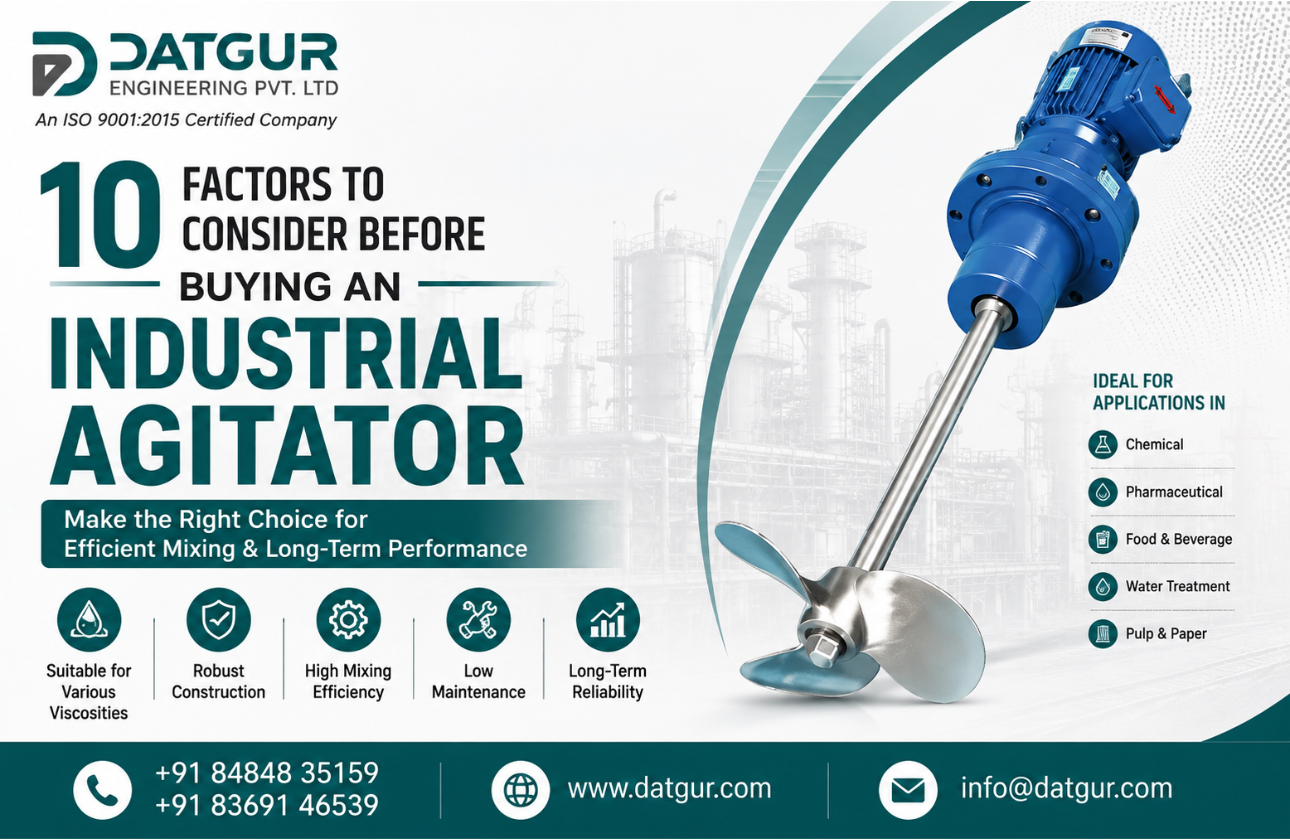
10 Factors to Consider Before Buying an Industrial Agitator
Selecting the right industrial agitator is more than choosing a motor and impeller. The performance of your mixing process, product quality, energy consumption, and maintenance costs all depend on whether the agitator matches your application. A poorly selected unit can lead to inconsistent mixing, increased downtime, and unnecessary operational expenses.
Whether you're installing a new process line or upgrading an existing system, evaluating these ten factors before purchasing an industrial agitator can help ensure long-term efficiency and reliability.
1. Understand the Nature of the Liquid
Every liquid behaves differently during mixing. Water-like fluids require a different agitator than highly viscous materials such as polymers, slurries, or syrups.
Before selecting an agitator, evaluate:
- Viscosity
- Density
- Temperature
- Solid particle concentration
- Corrosive properties
Choosing an agitator based on fluid characteristics ensures efficient mixing while reducing power consumption and mechanical stress.
2. Define Your Mixing Objective
Not every process requires the same type of agitation.
Ask yourself what the agitator is expected to achieve:
- Blending two liquids
- Suspending solid particles
- Dissolving powders
- Chemical reaction mixing
- Heat transfer
- Maintaining uniform concentration
The answer determines the impeller design, speed, and motor capacity required for optimum performance.
3. Select the Right Agitator Type
Industrial agitators are available in multiple configurations, each designed for specific applications.
Common options include:
- Top Entry Agitators
- Side Entry Agitators
- Bottom Entry Agitators
- Portable Agitators
- Clamp Mounted Agitators
Each design offers different advantages depending on tank geometry, installation space, and process requirements.
Selecting the correct type improves mixing efficiency while simplifying maintenance.
4. Tank Size and Geometry Matter
An agitator cannot perform efficiently without considering the mixing vessel.
Important parameters include:
- Tank diameter
- Liquid height
- Tank shape
- Presence of baffles
- Bottom design
A large tank may require multiple impellers or higher power output, while smaller vessels often perform well with compact mixing systems.
Matching the agitator to the vessel geometry prevents dead zones and ensures uniform circulation throughout the tank.
5. Choose the Appropriate Impeller Design
The impeller is the heart of every agitator.
Different impellers create different flow patterns.
Popular designs include:
- Propeller
- Turbine
- Paddle
- Anchor
- Helical Ribbon
Low-viscosity liquids generally perform well with propeller impellers, while high-viscosity applications benefit from anchor or helical ribbon designs.
Selecting the wrong impeller can reduce mixing efficiency, increase operating costs, and extend batch processing time.
6. Consider Speed and Power Requirements
Agitator speed directly affects mixing performance.
High-speed agitators are commonly used for rapid blending and dispersion, whereas slow-speed units are better suited for viscous fluids and delicate products.
The motor should provide enough torque without consuming excessive energy.
Oversized motors increase operating costs, while undersized motors struggle under heavy loads and may fail prematurely.
Balancing speed and power is essential for efficient and economical operation.
7. Material of Construction
Industrial environments often involve aggressive chemicals, abrasive slurries, or hygienic applications.
Choosing the correct material extends equipment life and reduces maintenance.
Common materials include:
- SS304 Stainless Steel
- SS316 Stainless Steel
- Duplex Stainless Steel
- Mild Steel with protective coating
- Special alloy materials
For corrosive chemicals and sanitary applications, stainless steel remains the preferred choice because of its excellent corrosion resistance and ease of cleaning.
8. Industry-Specific Requirements
Different industries have unique operational standards.
For example, Agitators for Pharmaceutical Industry must comply with strict hygiene, GMP standards, and contamination-free processing. They often require polished stainless-steel surfaces, sanitary seals, precision-engineered impellers, and easy-to-clean designs that support Clean-in-Place (CIP) and Sterilize-in-Place (SIP) systems.
Similarly, agitators used in food processing, chemicals, wastewater treatment, and cosmetics are designed to meet the specific process demands and regulatory requirements of those industries.
Choosing an agitator built specifically for your industry improves product quality, operational safety, and regulatory compliance.
9. Maintenance and Serviceability
Maintenance is often overlooked during equipment selection.
A well-designed agitator should allow easy access to:
- Bearings
- Mechanical seals
- Gearbox
- Motor
- Couplings
Quick maintenance reduces downtime and lowers servicing costs throughout the equipment's lifecycle.
Availability of spare parts and reliable technical support should also influence your buying decision.
10. Choose an Experienced Manufacturer
The quality of an industrial agitator depends not only on its components but also on the engineering expertise behind its design.
A trusted manufacturer evaluates:
- Process requirements
- Fluid characteristics
- Operating conditions
- Tank dimensions
- Performance expectations
Instead of offering a standard solution, experienced manufacturers provide customized agitators that deliver higher efficiency and longer service life.
Before making a purchase, check the manufacturer's industry experience, engineering capabilities, quality certifications, after-sales support, and track record across different industrial applications.
A reliable supplier becomes a long-term process partner rather than just an equipment vendor.
An industrial agitator is a long-term investment that directly influences production efficiency, product consistency, and operating costs. Looking beyond price and evaluating factors such as fluid properties, tank design, impeller selection, material construction, maintenance requirements, and industry-specific needs helps ensure the equipment performs reliably for years.
Whether your application involves water treatment, chemicals, food processing, or Agitators for Pharmaceutical Industry, selecting the right agitator improves mixing performance, minimizes downtime, and maximizes return on investment. Careful planning today can prevent costly modifications and operational challenges in the future, making the right agitator an essential component of an efficient industrial process.