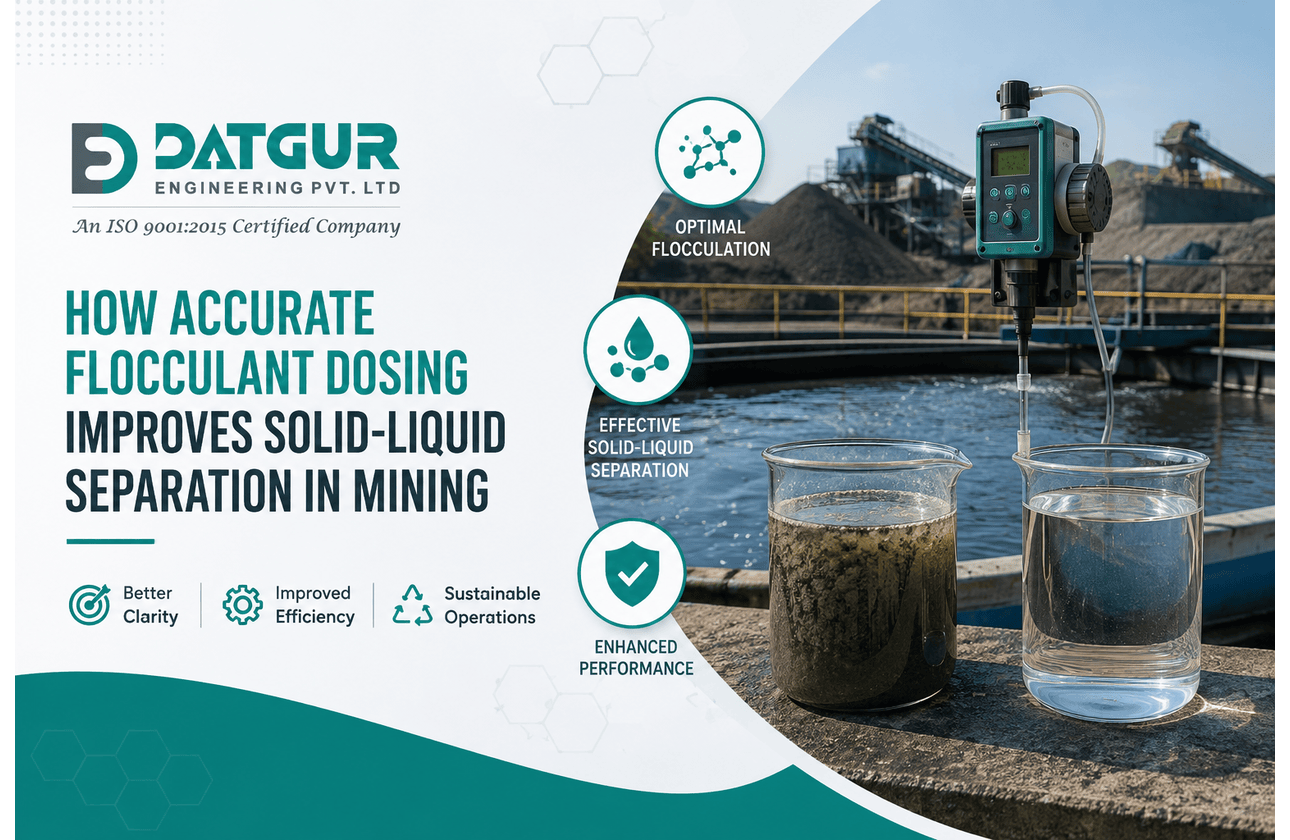
In many mining operations, thickener performance can change frequently. Mud levels fluctuate, overflow becomes cloudy, underflow density drops and operators may increase or reduce polymer dosing to correct the problem. This reactive approach can increase flocculant consumption without providing stable results.
In many cases, the problem is not the flocculant itself but how it is prepared, controlled and dosed. Solid-liquid separation is a critical part of mineral processing, used in thickeners, clarifiers, counter-current decantation (CCD) circuits and tailings dewatering systems. Poor separation can affect throughput, water recovery, chemical consumption and downstream operations.
This blog explains how accurate flocculant dosing and automatic flocculant dosing can improve solid-liquid separation, process stability and water recovery in mining operations.
Why Solid-Liquid Separation Matters in Mining?
Solid-liquid separation is used in different stages of mining and mineral processing. The main objective is to separate solids from water efficiently while recovering as much usable water as possible.
Common applications include:
- Pre-leach thickeners: Concentrate slurry before the leaching process.
- CCD circuits: Separate solids and liquid during washing and recovery processes.
- Tailings thickeners: Increase solids concentration before disposal or further dewatering.
- Process-water clarifiers: Remove suspended solids before water is reused.
- Wastewater clarifiers: Treat plant wastewater before reuse or discharge.
- Filter-feed thickeners: Prepare slurry at the required density for filters and other dewatering equipment.
Good separation is generally indicated by clear overflow, dense underflow, stable mud-line conditions and controlled flocculant consumption.
How Flocculants Work in Mining?
Mining slurries often contain fine particles such as clay, slimes and metal hydroxides. These particles can remain suspended in water and settle very slowly. Flocculants are generally long-chain polymers, often polyacrylamide-based. They help suspended particles form larger groups called flocs.
The process can be understood as:
- Polymer chains attach to the surface of fine particles.
- The polymer connects multiple particles together.
- Larger flocs are formed.
- These flocs settle faster under gravity.
- Water separates from the solids more effectively.
The correct flocculant type and dosage are important because different ores and water conditions can require different polymer characteristics.
Types of Flocculants Used in Mining
Flocculant selection depends on the type of solids, water chemistry and separation process.
Common types include:
- Anionic PAM: Used in several mineral processing and tailings applications.
- Cationic PAM: Used for certain sludge, clay and waste streams.
- Nonionic and specialty polymers: Used where specific process or water chemistry requires different polymer characteristics.
Selecting the correct polymer is the first step. Maintaining the correct dosage is equally important for consistent separation.
Why Accurate Flocculant Dosing Is Important
Flocculant dosage has a direct effect on floc formation and settling performance. Both under-dosing and over-dosing can reduce process efficiency.
Under-Dosing
When the flocculant dose is too low:
- Fine particles may not form strong flocs.
- Settling becomes slower.
- Overflow turbidity can increase.
- Underflow density may remain low.
- More solids can remain suspended in the process water.
Over-Dosing
When too much polymer is added:
- Chemical consumption increases.
- Slurry viscosity may increase.
- Floc structure can be affected.
- Bed compaction may become less effective.
- Additional polymer may provide little or no process benefit.
Unstable Dosing
When the polymer dose frequently changes without proper process control:
- Mud-line levels can fluctuate.
- Thickener performance becomes inconsistent.
- Operators need to make frequent adjustments.
- Process KPIs become difficult to maintain.
The objective is to maintain the optimum dosing range according to current operating conditions.
How Accurate Dosing Improves Solid-Liquid Separation?
Accurate flocculant dosing improves particle settling, overflow clarity, underflow density, water recovery and overall separation efficiency.
Better Floc Formation and Faster Settling
Accurate dosing provides the required amount of polymer for the current process conditions. This helps produce flocs with suitable size and strength.
Better floc formation can result in:
- Faster particle settling.
- Better solids removal.
- Improved thickener capacity.
- More consistent separation performance.
Stable Mud Line and Bed Conditions
The mud line inside a thickener changes when solids loading, settling and underflow withdrawal are not properly balanced. Accurate dosing helps maintain more consistent flocculation and settling conditions, which can support:
- Stable mud-line levels.
- Better bed formation.
- Consistent underflow density.
- Reduced risk of solids carryover.
Clearer Overflow
Fine particles that do not settle can move into the overflow and increase turbidity.
With accurate dosing:
- More fine particles form settleable flocs.
- Solids carryover can be reduced.
- Overflow clarity can improve.
- Recovered water can become more suitable for process reuse.
Higher Underflow Density
Effective flocculation allows solids to settle and compact more efficiently in the thickener bed. Higher underflow density can help:
- Reduce the amount of water carried with solids.
- Reduce slurry volume.
- Improve downstream dewatering.
- Reduce pumping requirements per tonne of solids.
Better Control of Polymer Consumption
Automatic dosing allows the polymer dose to respond to changing process conditions instead of maintaining a constant safety margin. This can help:
- Reduce unnecessary over-dosing.
- Maintain more consistent polymer consumption.
- Improve chemical cost control.
- Reduce manual dosing adjustments.
Actual polymer savings vary according to ore characteristics, polymer selection, feed conditions and the existing dosing method. Plant trials and operating data should be used to determine the actual improvement.
Improved Water Recovery
Better solid-liquid separation can improve the quality of the overflow and increase the amount of water available for reuse. At the same time, denser underflow carries less water with the solids. Together, these improvements can support:
- Higher process-water recovery.
- Lower fresh-water consumption.
- Reduced water loss through tailings.
- Better water management at the mining site.
More Stable Operation During Feed Changes
Mining feed conditions are rarely constant. Changes in ore blend, flow rate, solids concentration and water chemistry can affect flocculant requirements. Automatic dosing can respond to these changes and adjust the polymer dose according to the selected control strategy.
This helps reduce:
- Frequent operator intervention.
- Thickener instability.
- Dosing fluctuations.
- Process upsets during changing feed conditions.
Role of Process Data in Automatic Dosing
Automatic dosing systems can provide useful operating data for process engineers and plant operators.
Depending on the system configuration, data may include:
- Flocculant dosing rate.
- Feed flow rate.
- Settling rate.
- Mud-line level.
- Overflow turbidity.
- Underflow density.
- Polymer consumption.
This information helps teams identify process trends, understand dosing requirements and investigate the causes of separation problems.
With continuous data, flocculant dosing can be optimized based on actual plant performance rather than only operator experience.
Applications of Accurate Flocculant Dosing in Mining
Accurate flocculant dosing supports efficient solid-liquid separation across thickeners, CCD circuits, tailings systems and mining wastewater treatment.
Pre-Leach Thickening
Accurate dosing helps improve slurry thickening before leaching by supporting effective particle settling and higher solids concentration.
CCD Circuits
In CCD systems, consistent separation between solids and liquid is important at each stage. Controlled flocculant dosing can support stable thickener performance and efficient washing.
Tailings Thickeners
Accurate dosing can help produce denser tailings underflow, reducing the amount of water carried with tailings and supporting further dewatering or paste-tailings processes.
Process Water and Wastewater Clarification
In water and wastewater treatment applications, controlled flocculant dosing helps remove suspended solids and maintain consistent overflow quality for reuse or discharge.
Conclusion
Accurate flocculant dosing is an important part of efficient solid-liquid separation in mining. The correct polymer dose helps improve floc formation, particle settling, overflow clarity and underflow density.
Automatic flocculant dosing provides better control when feed conditions change and can help reduce unnecessary polymer consumption, improve water recovery and maintain more stable thickener performance.
For mining operations, water treatment plants and other industries handling high-solids slurry, a properly designed automatic dosing system can provide better process control and more consistent separation results.
Need Better Control Over Flocculant Dosing?
Datgur Engineering is a reliable Flocculant Dosing System Manufacturer offering solutions for accurate polymer preparation, mixing and dosing in industrial water and wastewater treatment applications. Flocculant Automatic Dosing System is designed for accurate polymer preparation, mixing and dosing in industrial water and wastewater treatment applications. The system uses real-time process data to adjust flocculant dosing according to changing water quality and solids conditions, helping improve flocculation, clarification and overall treatment performance.
- Automatic Flocculant Preparation: Automatically dilutes powdered or concentrated flocculants to the required concentration.
- Accurate Chemical Dosing: Precision dosing pumps inject the required amount of flocculant based on process conditions.
- Real-Time Monitoring: Sensors monitor parameters such as turbidity, flow, pH and suspended solids (TSS).
- Automatic Dose Adjustment: PLC-based controls compare live process data with setpoints and adjust dosing accordingly.
- Effective Mixing: An integrated mixing chamber helps distribute the flocculant uniformly through the treated water.
Contact Datgur Engineering at +91 8484835159 or info@datgur.com to discuss your process and dosing requirements.
FAQs
1. How does automatic dosing improve thickener performance?
It adjusts the flocculant dose according to selected process parameters, helping maintain consistent floc formation, settling, overflow clarity and underflow density.
2. What happens when too much flocculant is added?
Over-dosing can increase polymer consumption and may affect slurry viscosity, floc structure and bed compaction.
3. Can automatic dosing work with an existing thickener?
Yes, automatic dosing systems can often be integrated or retrofitted into existing thickener systems after checking the existing pumps, instruments, controls and process configuration.
4. How is dosing performance measured?
Performance can be evaluated using parameters such as settling rate, overflow turbidity, mud-line level, underflow density and flocculant consumption per tonne of solids.
5. Does automatic dosing eliminate the need for operators?
No. Automation reduces routine manual adjustments, but operators are still required for monitoring, maintenance, troubleshooting and process optimization.