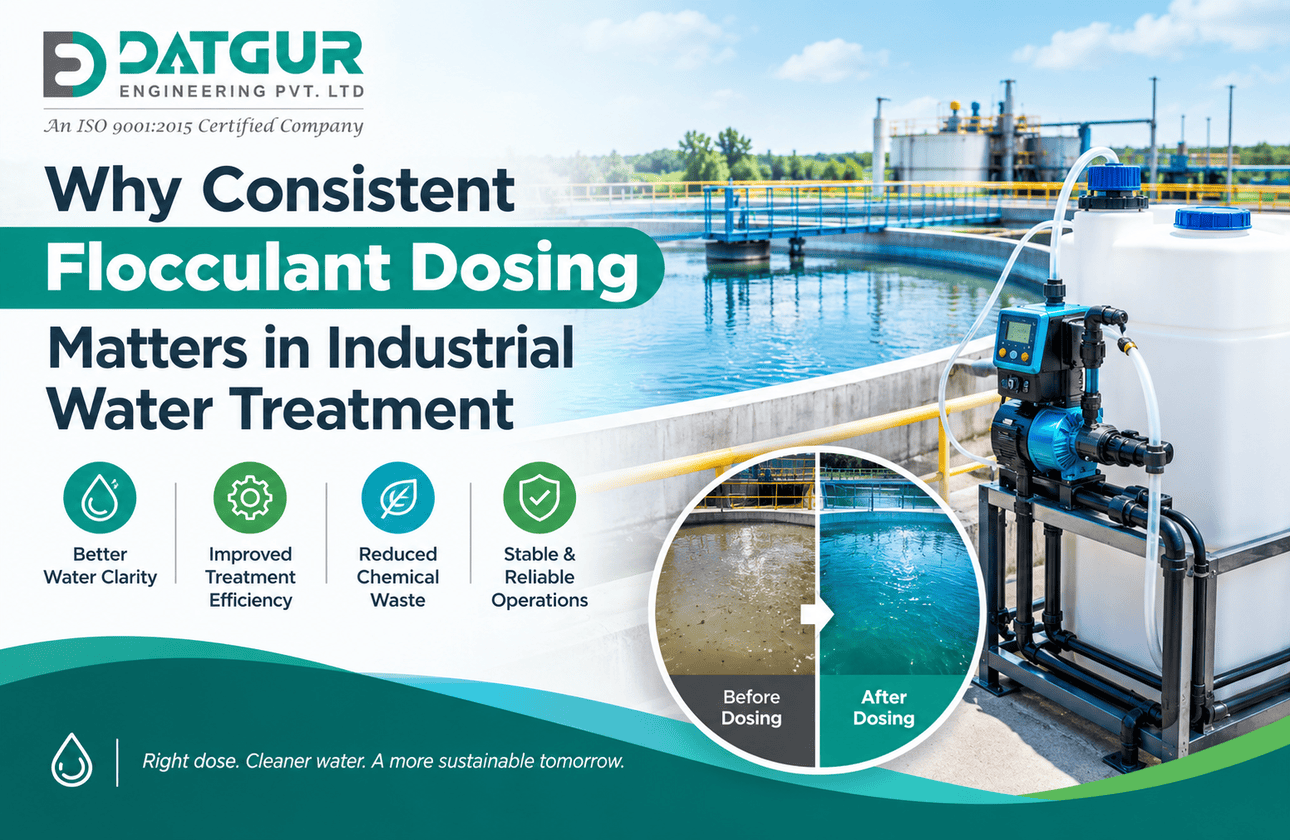
In industrial water and wastewater treatment, unstable floc formation can quickly become a costly problem. Operators may notice cloudy treated water, slow sludge settling, high TSS or increasing polymer consumption. While the flocculant may seem like the obvious issue, inconsistent dosing is often a major reason for poor and unstable results.
Flocculant dosing is the controlled addition of polymer chemicals to help fine particles combine into larger flocs that can be settled, floated or filtered. When the dose is not consistent, treatment performance can change from one batch or hour to another.
A properly designed flocculant dosing system helps prepare the polymer correctly and deliver a controlled dose according to the process requirement. This improves treatment consistency and gives operators better control over chemical consumption and sludge handling.
What is Flocculation?
Flocculation is a treatment process in which small suspended particles are brought together to form larger flocs. These larger particles are easier to remove through clarification, dissolved air flotation (DAF), filtration or sludge dewatering.
Flocculation normally follows coagulation:
- Coagulation: A coagulant destabilises fine particles and reduces their electrical charge.
- Flocculation: Gentle mixing allows the destabilised particles to join together and form larger flocs.
The flocculant plays an important role in building flocs with sufficient size and strength for the next treatment stage.
How Do Flocculants Work?
Flocculants are generally polymer-based chemicals that help particles attach to one another. After coagulation, the polymer forms bridges between particles, creating larger aggregates.
Depending on the treatment process, these flocs can then:
- Settle in clarifiers or thickeners
- Float in DAF systems
- Be captured through filtration
- Improve sludge dewatering in presses and centrifuges
The effectiveness of this process depends on the polymer type, concentration, mixing conditions and dosing rate.
Why Accurate Flocculant Dosing Is Important for Water Treatment
Consistent flocculant dosing is important for maintaining stable water treatment performance. The right dose helps form strong flocs, improve solids removal, control chemical consumption and protect downstream equipment.
1. Better Floc Formation and Solids Removal
Flocculants help small suspended particles join together to form larger flocs. When the polymer concentration and dosing rate are consistent, flocs form more evenly and can be removed more effectively.
This helps:
- Maintain stable clarifier and thickener performance
- Improve DAF float quality
- Provide a more consistent feed to filters and dewatering equipment
- Maintain better TSS and turbidity control
For food processing plants and ETPs, this means more stable effluent quality and fewer treatment problems.
2. Lower Chemical Consumption and Operating Costs
Inconsistent dosing can lead to both under-dosing and over-dosing. Operators may increase the polymer dose to avoid poor treatment, but excess polymer simply increases chemical consumption.
Consistent dosing helps:
- Control polymer use per cubic metre of wastewater
- Reduce unnecessary chemical costs
- Avoid excess sludge generation
- Reduce chemical storage and handling requirements
A properly designed flocculant dosing system helps maintain the required dose without frequent manual adjustments.
3. Stable Clarifier, DAF and Thickener Performance
Clarifiers, DAF units and thickeners work best when the incoming solids and floc characteristics remain within the expected range.
Consistent dosing helps maintain:
- Stable sludge blanket levels
- Uniform DAF float formation
- Better settling and separation
- Lower risk of sludge carryover
This is particularly important for plants operating continuously, where even small process variations can affect overall treatment performance.
4. Better Sludge Dewatering
The right flocculant dose affects how easily water can be separated from sludge. Consistent dosing helps produce sludge with more predictable characteristics for equipment such as belt presses, screw presses and centrifuges.
This can result in:
- Better dewatering performance
- More consistent sludge cake quality
- Easier sludge handling
- Lower sludge transportation and disposal requirements
For plants with high sludge generation, better dewatering can have a direct impact on operating costs.
5. Fewer Process Upsets and Emergency Adjustments
When dosing changes frequently, treatment performance can move between under-dosing and over-dosing. Operators then have to make repeated manual adjustments.
This can lead to:
- Sudden changes in TSS or turbidity
- More manual intervention
- Difficulty identifying the actual cause of problems
- Emergency chemical dosing
Flow-proportional dosing and online monitoring can help maintain a more stable dosing rate and reduce these fluctuations.
6. Better Control of Discharge Quality
Effective coagulation and flocculation play an important role in removing suspended solids from wastewater. Consistent flocculant dosing helps maintain more stable TSS and turbidity levels.
This supports plants in:
- Maintaining required discharge quality
- Reducing the risk of treatment failures
- Meeting applicable regulatory or customer requirements
- Maintaining better process records
For food processing and other industries supplying large customers, consistent wastewater quality can also support customer audits and internal compliance requirements.
7. Improved Downstream Equipment Performance
Poor solids removal can increase the load on downstream equipment such as sand filters, activated carbon filters, membranes and disinfection systems.
Better flocculation can help:
- Reduce solids reaching downstream units
- Extend filter operating cycles
- Reduce membrane fouling
- Improve the performance of final treatment stages
- Reduce cleaning and maintenance requirements
This is especially useful when treated water is reused for industrial or utility applications.
8. Easier Troubleshooting and Process Control
When flocculant dosing is stable, operators can more easily identify why treatment performance changes.
For example, if TSS increases despite a consistent polymer dose, the operator can investigate other factors such as:
- Influent flow
- TSS load
- pH
- Coagulant dose
- Polymer quality
- Mixing conditions
This reduces guesswork and makes process optimisation easier.
9. Lower Operator Workload
Manual dosing requires frequent monitoring, calculations and pump adjustments. This can increase the chance of human error, especially during shift changes or high-workload periods.
An automated flocculant dosing system can help by providing:
- Automatic dosing control
- Setpoints and alarms
- Level monitoring
- Flow-based dosing
- Data logging
- PLC/SCADA integration
This allows operators to spend more time monitoring overall plant performance instead of making repeated dosing adjustments.
10. Better Long-Term Plant Economics
Consistent flocculant dosing is not only a treatment issue—it also affects the overall operating cost of the plant.
Better dosing control can help reduce:
- Polymer consumption
- Sludge handling and disposal costs
- Equipment cleaning
- Maintenance requirements
- Unplanned process interruptions
Key Control Points in Flocculant Dosing
A reliable dosing system should control the important operating parameters, including:
- Polymer solution concentration
- Dosing pump flow or stroke
- Wastewater flow rate
- Polymer dose per unit of wastewater
- Mixing intensity and contact time
- Tank levels and system alarms
For plants with changing flow or wastewater loads, flow-proportional dosing or feedback-based control can provide better consistency than fixed manual dosing.
Main Components of a Flocculant Dosing System
A typical system may include:
- Dry polymer feeder or liquid polymer transfer unit
- Wetting head or eductor
- Polymer mixing tank
- Agitator
- Maturation or holding chamber
- Prepared-solution storage tank
- Dosing pump
- Control panel
- Level switches and alarms
- Injection and flushing arrangements
The exact configuration depends on polymer type, plant capacity, required automation and application conditions.
Benefits of a Properly Designed Flocculant Dosing System
A well-designed system can help industrial plants achieve:
- More consistent floc formation
- Better solids separation
- Controlled polymer consumption
- More stable clarification and DAF performance
- Improved sludge dewatering
- Lower operator intervention
- Better process monitoring
- More reliable treatment performance
The actual improvement depends on wastewater characteristics, polymer selection, equipment sizing and operating conditions.
Installation and Operating Best Practices
During Installation
- Position the dosing system close to the application point where practical.
- Provide proper spill containment and safe chemical handling arrangements.
- Ensure adequate mixing and polymer maturation time.
- Select an injection point that provides good distribution without excessive shear.
During Operation
- Prepare polymer solution according to the chemical supplier's recommendations.
- Avoid incorrect polymer concentration.
- Check and calibrate dosing pumps regularly.
- Monitor floc formation and treated-water quality.
- Record polymer consumption and process conditions.
- Adjust dosing based on actual plant performance rather than guesswork.
Conclusion
Consistent flocculant dosing is an important part of stable industrial water and wastewater treatment. The right polymer alone is not enough; it must be prepared at the correct concentration and dosed consistently according to process conditions.
A properly designed flocculant dosing system can help plants improve solids separation, control polymer consumption, reduce operator intervention and maintain more predictable treatment performance.
Need Reliable and Consistent Flocculant Dosing?
Datgur Engineering’s Flocculant Automatic Dosing System is designed to automate polymer preparation, mixing and dosing for industrial water and wastewater treatment. It helps maintain consistent dosing and supports stable floc formation, solids removal and overall treatment performance.
Suitable for ETPs, WTPs, STPs, DAF systems and sludge dewatering applications, the system can be configured according to plant flow and process requirements. Contact Datgur Engineering to discuss your flocculant dosing requirements.
Call: +91 8484835159 | Email: info@datgur.com
Frequently Asked Questions
1. What is flocculant dosing?
Flocculant dosing is the controlled addition of polymer chemicals to help suspended particles form larger flocs for easier separation.
2. Why is consistent flocculant dosing important?
Consistent dosing helps maintain stable floc formation, reliable solids removal and better control over chemical consumption.
3. What happens when flocculant is under-dosed?
Under-dosing can produce weak flocs, poor settling and higher TSS in treated water.
4. What happens when flocculant is over-dosed?
Over-dosing can increase polymer costs, create sticky sludge and affect downstream dewatering performance.
5. How is the correct polymer dose determined?
The correct dose is normally established through jar testing, pilot trials and monitoring of actual plant performance.