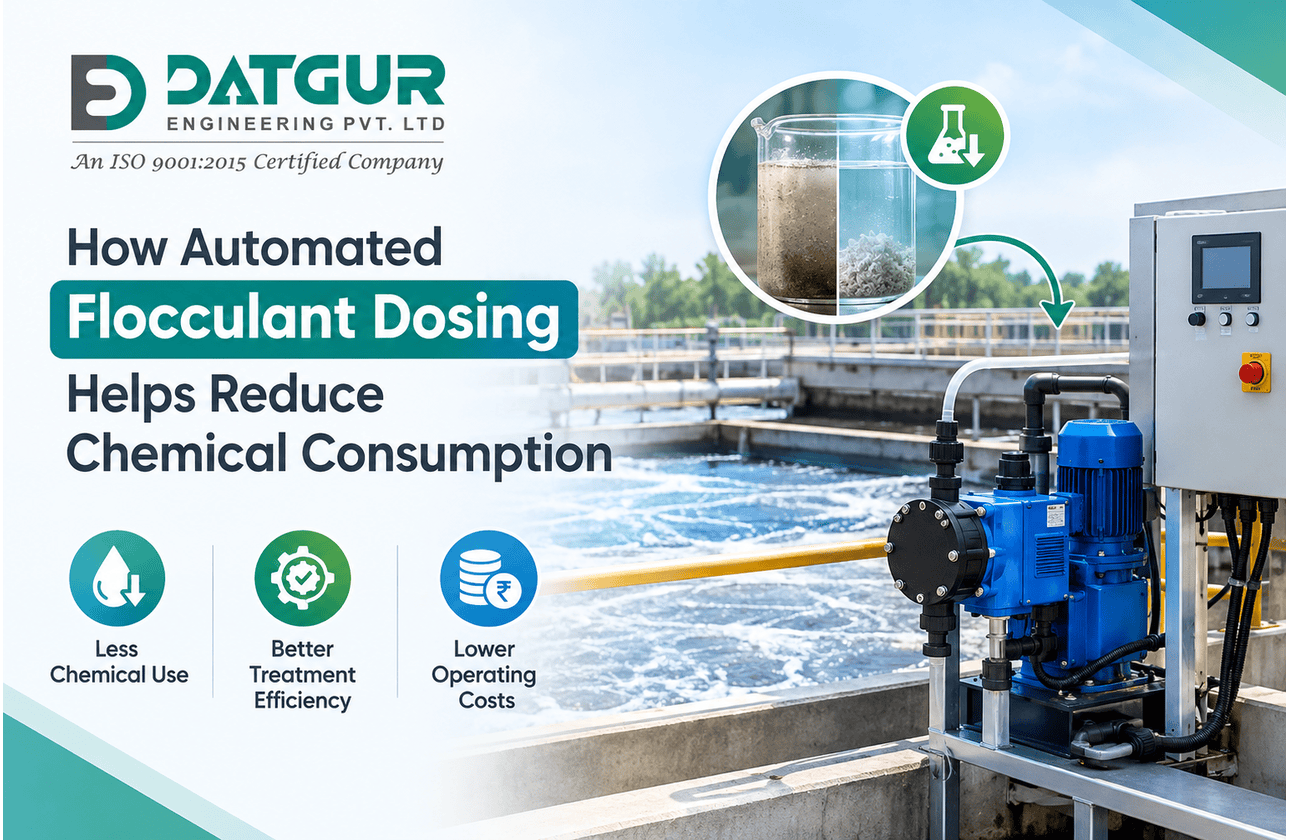
Flocculant consumption is a major operating cost for many wastewater treatment, ETP and sludge dewatering plants. When polymer dosing is based on fixed settings or operator judgement, plants may use more chemical than necessary without getting better treatment results.
The problem is often not the flocculant itself, but how it is prepared, controlled and dosed.
Flocculants help fine particles combine into larger flocs so they can settle or dewater more effectively. However, changing flow, solids concentration, sludge characteristics and water quality can make fixed-rate dosing unreliable.
An automatic flocculant dosing system uses real-time process information to adjust chemical dosing according to actual operating conditions. This can help reduce unnecessary polymer consumption while maintaining stable dewatering and treatment performance.
This guide explains how automated dosing works, where chemical savings come from, and what we should consider before implementing the system.
What Are Flocculants and Why Does Consumption Matter?
Flocculants are chemicals used to bring fine suspended particles together and form larger flocs. These flocs settle faster and can be separated from water more efficiently.
Common chemicals used in treatment processes include:
- Polyacrylamide (PAM): widely used for sludge dewatering and solid-liquid separation.
- Polyethyleneimine (PEI): used in selected industrial applications.
- Inorganic coagulants: such as alum and ferric salts, often used with polymer flocculants.
Flocculants are used in:
- Sludge dewatering
- Effluent treatment plants
- Water treatment plants
- Clarifiers
- Dissolved air flotation (DAF) systems
- Mining and mineral processing
- Industrial wastewater treatment
Because polymer chemicals can be costly, even small improvements in dosing efficiency can have a noticeable impact on operating expenses.
How an Automated Dosing System Helps Reduce Flocculant Consumption
An automated dosing system adjusts flocculant dosing according to real-time process conditions, helping reduce chemical waste and maintain consistent treatment performance.
1. Dosing Based on Actual Process Load
- Monitors flow rate, TSS, turbidity, solids concentration and other process parameters.
- Increases flocculant dosing when the solids load or flow increases.
- Reduces dosing when the process load decreases.
- Helps avoid fixed-rate dosing and unnecessary chemical addition.
- Maintains a more consistent dose per m³ of wastewater or tonne of dry solids.
2. Faster Response to Process Changes
- Continuously monitors changing wastewater and sludge conditions.
- Automatically responds to flow variations, production changes and changes in solids concentration.
- Reduces the need for frequent manual pump adjustments.
- Helps prevent over-dosing during sudden process changes.
- Supports more stable effluent and dewatering performance.
3. Better Mixing and Floc Formation
- Coordinates flocculant dosing with polymer preparation and mixing conditions.
- Helps achieve proper polymer activation and distribution.
- Produces stronger and more stable flocs when the dose and mixing conditions are correctly controlled.
- Reduces the need to increase chemical dosage to compensate for poor floc formation.
- Supports better settling, clarification and sludge dewatering.
4. Consistent Polymer Preparation
- Automatically controls polymer concentration, water flow and mixing time.
- Reduces variations caused by manual polymer preparation.
- Helps prevent under-activation or incorrect polymer concentration.
- Provides more predictable flocculant performance.
- Reduces compensatory over-dosing caused by inconsistent polymer preparation.
5. Data-Based Dosing Optimisation
- Records dosing rate, flow, solids loading, turbidity and treatment performance.
- Allows operators to identify periods of excessive chemical consumption.
- Helps engineers optimise dosing setpoints and control parameters.
- Supports comparison of polymer consumption before and after process changes.
- Provides useful data for continuous process improvement.
By combining real-time monitoring, accurate dosing, controlled polymer preparation and an understanding of flocculant chemical composition, the system can reduce chemical wastage while maintaining stable treatment and dewatering performance.
Main Components of an Automatic Flocculant Dosing System
A typical system may include:
- Flow sensors for monitoring wastewater or sludge flow.
- TSS or solids sensors for measuring solids loading.
- Turbidity sensors for monitoring water quality.
- Dosing pumps for accurate chemical injection.
- Polymer preparation units for consistent flocculant concentration.
- Mixing systems for proper polymer activation and distribution.
- PLC or controller for automatic process control.
- HMI/SCADA for monitoring, alarms, trends and operator control.
The exact configuration depends on the treatment process and required control strategy.
Where Can Plants Achieve the Biggest Savings?
Automated flocculant dosing can reduce chemical costs across sludge dewatering, industrial ETPs, water treatment plants and mining applications.
Sludge Dewatering
In centrifuges, belt filter presses and screw presses, polymer dosing directly affects floc formation and cake quality.
Optimised dosing can help maintain:
- Stable cake solids
- Better filtrate clarity
- Consistent dewatering
- Lower polymer consumption
Industrial ETPs
- Food processing, chemical, textile and other industrial plants often experience changes in wastewater load.
- Automatic dosing can adjust chemical addition according to changing operating conditions instead of maintaining one fixed dose.
Water Treatment Plants
Clarifiers and other treatment units can use automated dosing to maintain consistent chemical addition when flow or water quality changes.
Mining and Mineral Processing
Thickeners and dewatering systems handle changing solids loads and process conditions. Automated flocculant dosing can help maintain stable settling and improve process control.
How to Measure Flocculant Savings
Simply reducing the pump speed does not prove that the plant is using flocculant more efficiently.
A proper comparison should consider:
- Flocculant consumption per tonne of dry solids
- Flocculant consumption per cubic metre treated
- Cake solids content
- Filtrate or effluent turbidity
- TSS levels
- Sludge disposal quantity
- Overall chemical cost
Before and after data can help determine whether automation is actually improving dosing efficiency.
Is Automatic Dosing Suitable for Every Plant?
Automatic dosing can be particularly useful for plants with:
- High flocculant consumption
- Variable flow or solids loading
- Frequent manual dose adjustments
- Inconsistent dewatering results
- High sludge disposal costs
- Strict effluent quality requirements
For plants with very stable operating conditions, a simpler control system may be sufficient. The appropriate level of automation depends on the process, operating variability and business case.
Need Better Control Over Flocculant Consumption?
Datgur Engineering’s Flocculant Automatic Dosing System provides accurate polymer preparation, mixing and dosing based on real-time process conditions. By automatically adjusting the dose according to flow, TSS, turbidity and other parameters, it helps reduce over-dosing, minimise chemical wastage and maintain consistent treatment performance.
Benefits
- Accurate and controlled flocculant dosing
- Reduced unnecessary chemical consumption
- Automatic polymer preparation and mixing
- Real-time process monitoring
- PLC/SCADA integration
- Stable flocculation and clarification performance
Choose Datgur for reliable and efficient flocculant dosing in water and wastewater treatment plants.
Conclusion
Reducing flocculant consumption is not simply about reducing the chemical dose. The objective is to use the right amount of polymer for the actual process conditions while maintaining treatment performance.
An automatic flocculant dosing system can help plants achieve this through real-time monitoring, controlled polymer preparation, accurate dosing and continuous process adjustment.
For water treatment plants, ETPs and sludge dewatering facilities, the right flocculant chemical composition combined with accurate dosing can help reduce chemical consumption, improve dewatering, maintain stable operation and control operating costs.
Frequently Asked Questions
1. What is an automatic flocculant dosing system?
An automatic flocculant dosing system measures process conditions and automatically adjusts polymer dosing according to the required operating parameters.
2. How does automatic dosing reduce flocculant consumption?
It adjusts the dose according to actual process conditions, helping avoid unnecessary over-dosing and maintaining the required treatment performance.
3. Can an automatic dosing system work with existing equipment?
Yes. Many systems can be integrated with existing dosing pumps, polymer preparation systems, PLCs, SCADA and process sensors.
4. Which industries use automatic flocculant dosing?
Common applications include water treatment, wastewater treatment, food processing, chemical industries, mining, mineral processing and sludge dewatering.
5. What parameters can be used for automatic dosing?
Depending on the application, control can use flow, TSS, solids concentration, turbidity, torque, floc characteristics and other process measurements.
6. How do I know if my plant is overdosing flocculant?
A high chemical consumption rate, unstable floc formation, poor dewatering results or frequent manual dose increases can indicate that the dosing strategy needs to be reviewed. Process testing is required to confirm the actual cause.
7. How often should the system be calibrated?
Calibration depends on the type of sensor, process conditions and manufacturer recommendations. Regular inspection and calibration are important for reliable automatic control.