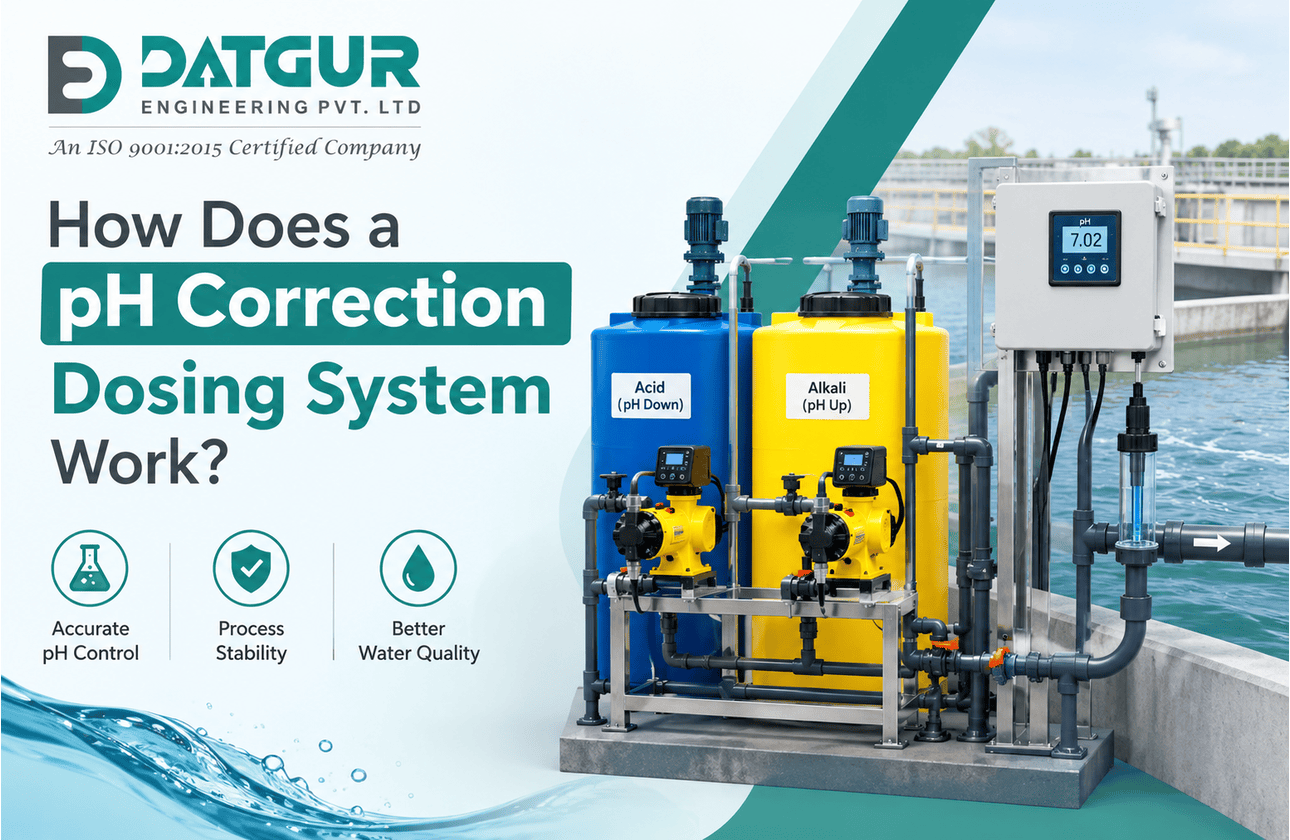
In industries such as water treatment, food processing, chemicals, pharmaceuticals, and manufacturing, maintaining the correct pH is essential for stable operations. An incorrect pH can affect treatment efficiency, increase chemical consumption, cause corrosion or scaling, and create problems in downstream processes.
A pH correction dosing system helps industries maintain the required pH automatically. It measures the pH of water or process liquid, compares the reading with the desired setpoint, and doses acid or alkali as required. This makes pH control more consistent while reducing manual intervention and chemical wastage.
What is a pH Correction Dosing System?
A pH correction dosing system is an automated setup that measures and controls the pH of water, wastewater, or process liquids.
A pH sensor continuously monitors the liquid. If the pH moves outside the required range, the controller activates a dosing pump to add the required chemical.
- Acid is dosed when pH is too high.
- Alkali is dosed when pH is too low.
For example, in an ETP, acid can be dosed into highly alkaline wastewater to bring the pH within the required range before further treatment. The goal is to maintain stable pH conditions while avoiding unnecessary chemical dosing.
Why is pH Control Important in Industrial Processes?
pH directly affects many industrial processes. Low pH can increase corrosion in pipelines, tanks and pumps, while high pH may cause scaling, poor chemical reactions and lower treatment efficiency.
In wastewater treatment, pH affects biological and chemical processes. In food processing, proper pH control supports cleaning, wastewater treatment and process-water quality.
- Maintain stable treatment conditions
- Reduce chemical wastage
- Protect equipment
- Improve downstream treatment performance
- Reduce manual monitoring
- Maintain the required discharge or process conditions
How Does a pH Correction Dosing System Work?
A pH correction dosing system works as a closed-loop control process. It continuously measures the liquid, compares the actual pH with the setpoint, doses the required chemical, and checks the pH again.
1. pH Sensor Measures the Liquid
- A pH probe is installed in a suitable location such as a treatment tank, pipeline, sample chamber, or recirculation line.
- The sensor continuously measures the pH of the liquid and sends the reading to the controller.
- Correct sensor placement is important. If the probe is installed in a poorly mixed area, it may not represent the actual pH of the complete liquid volume.
2. Controller Compares the pH with the Setpoint
- The pH transmitter or controller receives the sensor signal and compares it with the programmed target.
- For example:
Actual pH: 9.2
Target pH: 7.0–7.5
- The controller identifies that the liquid is too alkaline and initiates acid dosing.
3. Dosing Pump Starts or Adjusts Its Output
- The controller sends a signal to the dosing pump.
Depending on the control system, the pump can:
- Start or stop
- Change its dosing frequency
- Adjust stroke length
- Change motor speed
- Respond to an analogue or digital control signal
More advanced systems can automatically adjust the dosing rate according to the difference between the actual pH and the target.
4. Chemical Is Injected
- The dosing pump draws the selected chemical from the storage tank and delivers it to the process.
- The chemical may be injected into a treatment tank, pipeline, or neutralisation chamber through a suitable injection point.
Common chemicals include:
For increasing pH:
- Sodium hydroxide
- Lime or calcium hydroxide
- Soda ash
For reducing pH:
- Sulfuric acid
- Hydrochloric acid
- Carbon dioxide in selected applications
The chemical must be selected according to the process chemistry, required correction, concentration, safety requirements, and equipment compatibility.
5. Chemical Mixing Takes Place
Chemical dosing alone does not guarantee proper pH correction. The chemical must mix properly with the process liquid.
Mixing can be achieved using:
- Mechanical agitators
- Static mixers
- Recirculation pumps
- Pipeline turbulence
- Neutralisation tanks with sufficient retention time
Good mixing prevents localised high or low pH zones and helps the sensor receive a representative reading.
6. pH Is Measured Again
- After sufficient mixing, the pH is measured again.
- If the pH is within the required range, the controller reduces or stops dosing. If the pH is still outside the setpoint, the system continues controlled dosing.
- This continuous measure → compare → dose → mix → measure cycle allows the plant to maintain more stable pH conditions.
Main Components of a pH Correction Dosing System
A complete pH dosing system includes more than just a dosing pump. Each component has a specific role in maintaining safe and reliable operation.
| Component | Function |
| pH Sensor/Probe | Measures the pH of water or process liquid |
| pH Controller/Transmitter | Receives sensor data and controls the dosing process |
| Dosing Pump | Injects a controlled quantity of acid or alkali |
| Chemical Storage Tank | Stores the dosing chemical |
| Agitator/Mixer | Provides uniform mixing where required |
| Suction Strainer | Helps prevent unwanted particles from entering the pump |
| Foot Valve | Supports proper chemical suction from the tank |
| Injection Quill | Introduces the chemical into the process line |
| Non-Return Valve | Prevents process liquid from flowing back into the dosing line |
| Pressure Relief Valve | Protects the dosing system from excessive pressure |
| Level Switch | Indicates low chemical level and can provide a pump interlock |
| Secondary Containment | Helps contain chemical leakage or spills |
The actual configuration depends on the chemical, flow rate, pressure, tank arrangement, control requirements, and plant safety standards.
Which Dosing Pumps Are Used for pH Correction?
The dosing pump is one of the most important components of the system. The right pump depends on the required flow rate, pressure, chemical properties, dosing accuracy, and operating conditions.
- Solenoid Dosing Pumps: Ideal for low-flow chemical dosing and compact water-treatment systems.
- Mechanical Diaphragm Pumps: Suitable for reliable dosing of acids and alkalis in industrial applications.
- Hydraulic Diaphragm Pumps: Designed for high-pressure and demanding chemical-dosing applications.
- Peristaltic Pumps: Suitable for certain viscous, abrasive, or sensitive liquids with good fluid isolation.
- Pump Selection: Choose the pump based on flow rate, pressure, chemical properties, dosing accuracy, and operating conditions.
Common Control Methods for pH Dosing
Different plants require different levels of automation.
- Manual Control: The operator checks pH and adjusts chemical dosing manually; suitable for small, stable processes.
- On-Off Control: The pump starts or stops when pH moves outside the set range; simple but less precise.
- Proportional Control: Dosing rate changes according to the difference between actual and target pH.
- PID Control: Continuously adjusts dosing for precise pH control in plants with changing flow or wastewater conditions.
- Best for Industrial Use: Proportional or PID control is generally preferred for variable and critical processes.
Benefits of an Automatic pH Correction Dosing System
For industrial operators, automation offers several practical benefits:
- More consistent pH control compared with manual dosing
- Reduced chemical wastage through controlled dosing
- Lower operator involvement in routine pH adjustment
- Better protection against corrosion and scaling
- Improved downstream treatment performance
- Automatic alarms for abnormal pH or low chemical levels
- Easy integration with PLC and SCADA systems
- Better process monitoring and data recording
- Improved operational safety by reducing direct chemical handling
The actual benefit depends on correct system design, calibration, mixing, pump selection, and process conditions.
How to Select the Right pH Dosing System?
- Know the normal, minimum, and maximum incoming pH and the required outlet pH.
- Provide the average and maximum liquid flow rate.
- A system designed only for normal flow may not respond properly during peak conditions.
- Specify the chemical name, concentration, temperature, viscosity, and other relevant properties.
- The dosing pump must be capable of delivering the required chemical against the actual process pressure.
- Make sure there is sufficient mixing and contact time between chemical injection and final pH measurement.
- Wetted components such as the pump head, diaphragm, valves, tubing, tank and injection assembly must be compatible with the chemical.
- Determine whether the plant requires manual, on-off, proportional, or PID control and whether PLC/SCADA integration is needed.
- Acid and alkali dosing requires appropriate storage, containment, ventilation, interlocks, PPE provisions, and emergency arrangements.
Maintenance Tips for Reliable pH Dosing
Regular maintenance helps keep the system accurate and reduces unexpected downtime.
- Calibrate the pH sensor according to the application and manufacturer's recommendations.
- Clean the pH probe regularly, particularly when treating wastewater with high solids or contaminants.
- Inspect dosing pump valves, diaphragms, seals, and tubing for wear.
- Check suction strainers and foot valves for blockage.
- Inspect injection points for deposits or clogging.
- Check chemical tank levels and inspect the tank for leakage or damage.
- Verify dosing pump output periodically.
- Check pressure gauges and safety valves.
- Test alarms and pump interlocks.
- Review controller settings after maintenance or process changes.
For critical applications, keeping a standby dosing pump or essential spare parts can help reduce downtime.
What Makes Datgur’s pH Correction Auto Dosing System Different?
Datgur Engineering’s pH Correction Auto Dosing System is designed to maintain consistent pH levels in water, wastewater, and industrial process applications. The system combines a high-precision pH sensor, digital controller, chemical metering pumps, corrosion-resistant chemical tanks, and safety controls to continuously monitor pH and automatically dose acid or alkali when correction is required.
Its dual-dosing capability, PLC/HMI integration options, 4-20 mA/RS485/relay outputs, and IP65-protected enclosure make it suitable for demanding industrial environments. The system helps reduce manual intervention, improve dosing consistency, minimise chemical wastage, and support reliable process control in WTPs, ETPs, food processing plants, chemical industries, and other industrial applications.
Conclusion
A pH correction dosing system is more than a chemical pump connected to a pH sensor. It is a complete control system that combines accurate measurement, controlled chemical dosing, proper mixing, and feedback control.
For WTPs, ETPs, STPs, food processing plants, chemical industries, and other process industries, a properly designed system can help maintain stable pH, reduce chemical wastage, protect equipment, and improve treatment performance.
The key to reliable operation is selecting the right pH sensor, dosing pump, chemical, materials, mixing arrangement, and control method for the specific application.
Frequently Asked Questions
1. How does automatic pH dosing control chemical consumption?
It doses chemicals based on pH readings and adjusts the dosing rate to reduce over-dosing and chemical waste.
2. Which chemicals increase or decrease pH?
Sodium hydroxide, lime and soda ash increase pH, while sulfuric acid, hydrochloric acid and CO₂ can reduce it.
3. Can one system dose both acid and alkali?
Yes, a dual-dosing system can use separate pumps and tanks for acid and alkali with appropriate safety controls.
4. Which dosing pump is best for pH correction?
Pump selection depends on flow rate, pressure, chemical properties, dosing accuracy and automation requirements.
5. How often should a pH sensor be calibrated?
Calibration frequency depends on the process, sensor condition and required measurement accuracy.
6. Why is mixing important after chemical injection?
Proper mixing ensures even chemical distribution and helps achieve accurate, stable pH correction.
7. Can the system connect with PLC or SCADA?
Yes, industrial pH dosing systems can integrate with PLC or SCADA for monitoring, alarms, data logging and process control.