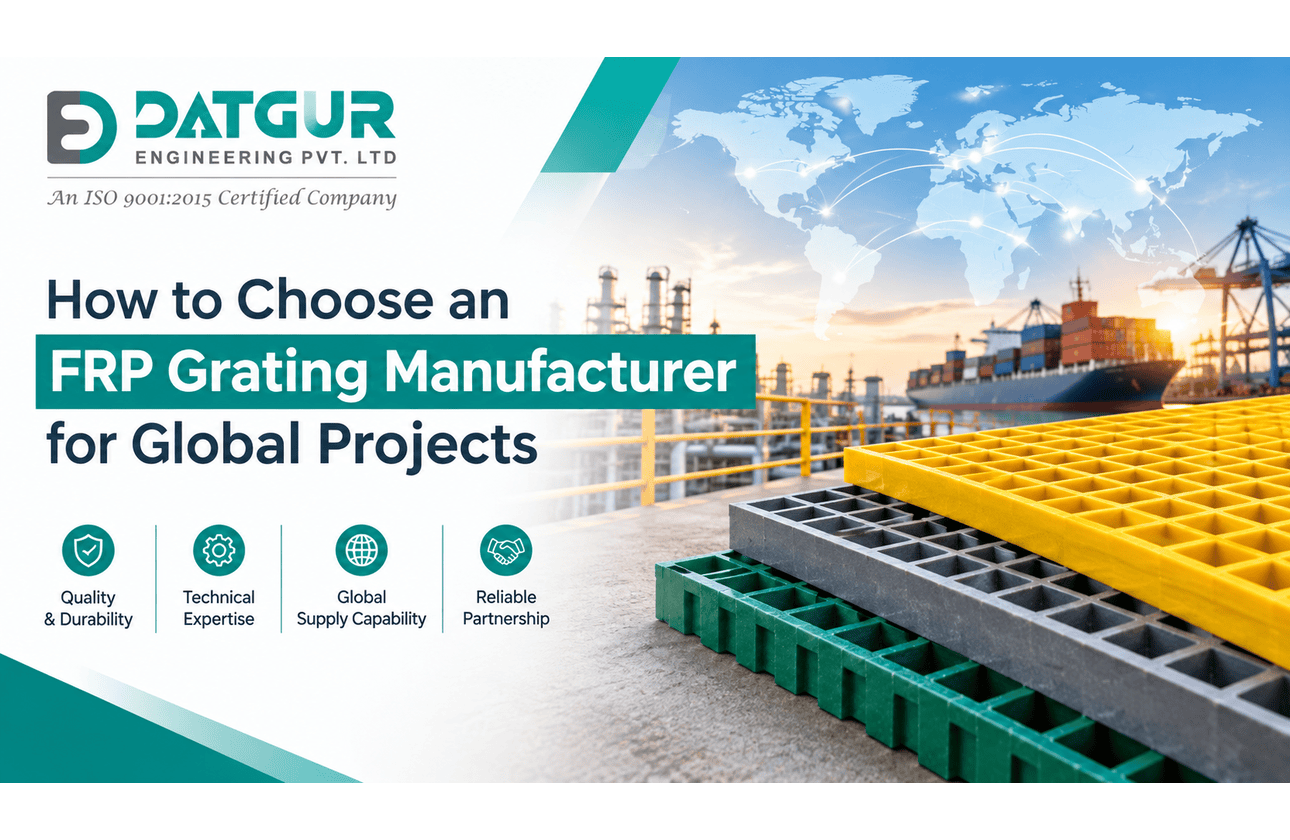
Choosing the wrong FRP grating manufacturer can turn a well-planned industrial project into a costly problem. Inconsistent quality, incorrect load-bearing capacity, delayed deliveries and poor export support can impact project timelines, safety and costs. For global projects, businesses need a manufacturing partner with strong technical expertise, reliable production capacity and international supply experience.
FRP gratings are widely used in chemical plants, wastewater facilities, offshore and marine environments, power plants, oil and gas facilities, and industrial walkways due to their corrosion resistance, durability and low maintenance.
Global buyers may also require customised sizes, specific resin systems, bulk production, export-ready packaging and timely delivery. Therefore, selecting an experienced FRP grating manufacturer is essential for ensuring product quality, reliable supply and smooth project execution.
What is FRP Grating for Industrial Projects
FRP grating is a composite product made using resin and glass-fibre reinforcement. Common resin systems include polyester, vinyl ester and phenolic.
Advantages include:
- High corrosion resistance
- High strength-to-weight ratio
- Non-conductive construction
- Slip-resistant surfaces
- Low maintenance
- Long service life
Common FRP Grating Applications
FRP grating is used in:
- Water & wastewater: Tank walkways, clarifier platforms and drainage areas
- Chemical & petrochemical: Platforms, process areas and pipe bridges
- Food & pharmaceutical: Hygienic walkways and drainage covers
- Power plants: Cooling tower platforms and access walkways
- Marine & offshore: Decks, platforms and walkways
- Mining and pulp & paper: Catwalks, platforms and trench covers
Why is FRP Grating Manufacturer Selection Important?
FRP grating quality depends on factors such as resin system, glass-fibre content, manufacturing process and quality control.
Poor-quality products may result in:
- Lower load performance
- Cracking or delamination
- Premature deterioration
- Safety risks
- Frequent replacement
- Project rework and delays
For global projects, buyers must also consider international standards, export packaging, documentation, shipping and after-sales support. A capable FRP grating manufacturer should be able to manage both technical and logistical requirements.
Criteria for Choosing an FRP Grating Supplier
Choose an FRP grating manufacturer based on product quality, manufacturing capacity, certifications, technical support, customisation and export experience.
1. Production Capacity
Check whether the manufacturer has:
- In-house manufacturing facilities
- Moulded and/or pultruded grating capabilities
- Capacity for large-volume orders
- Custom manufacturing capabilities
- Reliable production and delivery schedules
2. Product Range and Customisation
A reliable manufacturer should offer options for:
- Different mesh sizes and thicknesses
- Custom panel dimensions
- Gritted, concave or covered surfaces
- Special cut-outs and shapes
- Different resin systems
- Fixing clips and accessories
3. Quality Certifications and Testing
Ask for:
- ISO 9001 certification
- Relevant ASTM, BS, EN or project-specific compliance
- Load and deflection test reports
- Fire-performance test reports, where required
- Chemical-resistance data
- UV/weathering data for outdoor applications
Third-party inspection can also be considered for large or critical projects.
4. Technical and Engineering Support
The manufacturer should provide more than a product quotation.
Look for:
- Load calculations
- CAD/shop drawings
- Installation details
- Technical datasheets
- Material recommendations
- Design and span guidance
Good engineering support can help optimise grating thickness, span and support spacing.
5. Export Experience
For international projects, check the manufacturer's experience with:
- Middle East
- Europe
- Africa
- North America
- Other target markets
The manufacturer should understand export documentation, packaging, labelling, shipping and required certificates.
6. Resin and Material Quality
Resin selection depends on the application.
- Polyester: suitable for many general industrial applications
- Vinyl ester: better suited to aggressive chemical environments
- Phenolic: selected where fire and smoke performance is important
Also check glass-fibre reinforcement, fire-retardant options and UV-resistant grades where required.
7. Total Cost of Ownership
Do not compare suppliers only on price.
Consider:
- Product service life
- Maintenance requirements
- Replacement costs
- Freight and insurance
- Import duties and taxes
- Installation requirements
- Warranty and service support
A slightly higher initial price may provide better value when product quality and lifecycle performance are considered.
Step-by-Step Process to Evaluate an Industrial Manufacturer
Follow a structured evaluation process covering technical capabilities, certifications, product quality, export experience, communication and, overall project requirements.
Step 1- Define Project Requirements
Prepare details about:
- Application and environment
- Required load capacity
- Panel dimensions and quantities
- Chemical exposure
- Surface requirements
- Required standards
- Delivery schedule
Step 2- Shortlist Manufacturers
Use industry directories, B2B platforms, EPC references and professional recommendations.
Shortlist manufacturers that have FRP grating as a core product and can provide proper technical documentation.
Step 3- Verify Certifications
Request and verify:
- ISO certificates
- Product test reports
- Mechanical test data
- Fire-performance data
- Chemical-resistance information
- Relevant compliance documents
Step 4- Evaluate Manufacturing Facilities
Where possible, review the factory through an on-site visit, video inspection or virtual tour.
Check:
- Raw-material storage
- Production equipment
- Quality inspection facilities
- Testing equipment
- Finished-goods storage
- Export packaging
Step 5- Request Samples and Technical Data
Evaluate samples for:
- Surface finish
- Dimensional accuracy
- Bar spacing
- Thickness
- Edge quality
- Overall workmanship
Also review load tables, chemical-resistance data and other relevant technical documents.
Step 6- Assess Communication
For global projects, communication is critical.
Check the supplier's:
- RFQ response time
- Technical clarity
- Documentation quality
- Ability to handle design changes
- Coordination across time zones
Step 7- Check Previous Projects
Ask for references and project details from similar industries.
Relevant references may include:
- Water treatment plants
- Chemical plants
- Food processing facilities
- Power plants
- Offshore projects
Step 8- Finalise Commercial and Logistics Terms
Before placing the order, confirm:
- Product specifications
- Quantity and delivery schedule
- Packaging requirements
- Incoterms
- Inspection requirements
- Warranty
- Shipping documents
- After-sales support
Why Consider India for FRP Grating Sourcing?
India has a growing FRP manufacturing base with suppliers serving both domestic and international markets.
Key advantages can include:
- Competitive manufacturing costs
- Custom production capabilities
- Skilled engineering workforce
- Experience with international standards
- Export documentation support
- Flexible production for standard and custom requirements
For global buyers, Indian manufacturers can offer a balance of cost, technical capability and export support when properly evaluated.
What Makes Datgur FRP Gratings Suitable for Global Projects?
Datgur Engineering offers FRP Gratings engineered for industrial walkways, platforms, trench covers and safety flooring where corrosion resistance, load performance and electrical safety are important. The range includes moulded, pultruded and covered gratings with options for polyester, vinyl ester and phenolic resin systems.
Designed for applications such as water and wastewater treatment, chemical plants, power generation, food processing and marine environments, Datgur FRP Gratings offer high strength with lightweight construction, slip-resistant surfaces and low maintenance requirements. Custom sizes, mesh configurations and surface finishes are available based on project requirements.
For project-specific requirements, contact Datgur Engineering at +91 8484835159 or info@datgur.com to discuss suitable FRP grating specifications and configurations.
Conclusion
Choosing the right FRP grating manufacturer is important for maintaining safety, quality, project schedules and long-term operating performance. Buyers should evaluate manufacturing capability, material quality, testing, certifications, engineering support, export experience and total cost before placing an order.
For global water treatment, chemical, food processing, power and industrial projects, working with a technically capable manufacturer can reduce installation problems, delays and long-term maintenance costs. The right supplier should not only deliver FRP grating but also provide consistent quality, reliable documentation, technical support and dependable international project coordination.
FAQs
1. What is FRP grating used for?
FRP grating is used for industrial walkways, platforms, trench covers, drainage areas, stair treads and safety flooring.
2. How can I verify an FRP grating manufacturer's quality?
Check certifications, test reports, technical data, samples, manufacturing facilities and previous project references.
3. Which resin is best for FRP grating?
The suitable resin depends on chemical exposure, temperature, fire requirements and the operating environment.
4. Is molded or pultruded FRP grating better?
Moulded grating provides strength in two directions, while pultruded grating is suitable for applications requiring higher strength along the load direction and longer spans.
5. Can FRP grating be customised?
Yes. Manufacturers can provide different thicknesses, mesh sizes, panel dimensions, cut-outs, surfaces and fixing accessories based on project requirements.
6. How should I compare FRP grating quotations?
Compare specifications, resin type, load rating, testing, certifications, delivery, packaging, freight, warranty and lifecycle cost not only the unit price.
7. Do FRP grating manufacturers provide installation support?
Many manufacturers provide installation drawings, fixing details and technical guidance. Support depends on the supplier and project requirements.