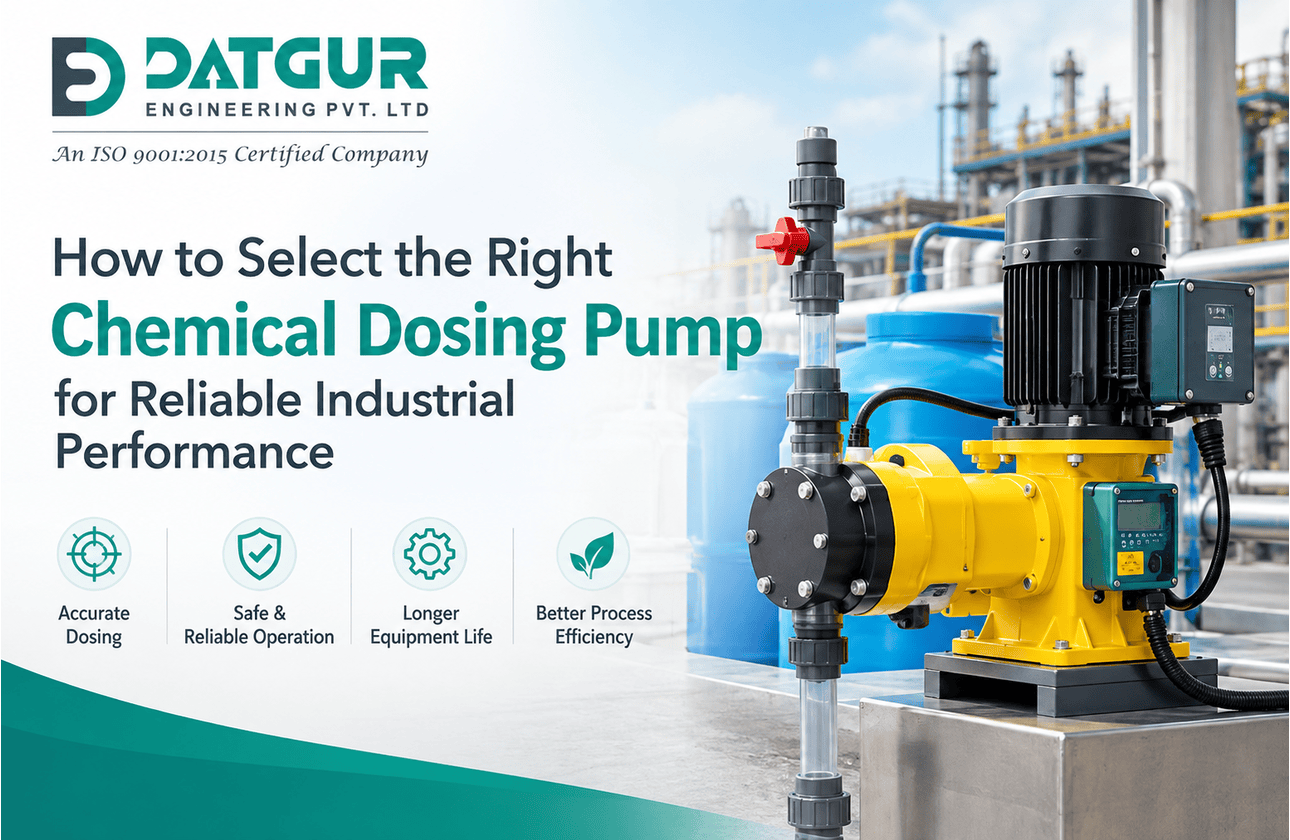
Industrial plants often face fluctuating water quality, high chemical consumption and frequent equipment maintenance. In many cases, the issue can be a wrong chemical dosing pump, incorrect pump sizing or poor system configuration. A chemical dosing pump is designed to inject a controlled quantity of chemical with accurate dosing, repeatability, pressure handling and chemical compatibility.
Choosing the right chemical dosing pump is important to avoid under-dosing, over-dosing, chemical wastage, equipment damage and process downtime. This guide covers the key factors for selecting a chemical dosing pump and how the right choice can improve process reliability, chemical efficiency, safety and overall plant performance.
What is a Chemical Dosing Pump?
A chemical dosing pump is generally a positive displacement pump that delivers a controlled volume of liquid into a process. Depending on the pump design, dosing can be controlled by stroke length, pump speed, flow rate, or an external control signal.
These pumps are used where accurate and repeatable chemical dosing is important.
The right dosing pump helps maintain stable process conditions while reducing unnecessary chemical consumption. It can also protect equipment such as membranes, filters, pipelines, heat exchangers and treatment units from problems caused by incorrect chemical dosing.
For industrial plants, a reliable dosing pump is not simply a pumping device. It is an important part of the process control system.
Factors to Consider When Selecting a Chemical Dosing Pump
Choosing the right pump starts with understanding the process. The following factors should be evaluated before selecting a model.
1. Understand the Chemical Being Dosed
The chemical is one of the most important factors in pump selection.
- Different chemicals have different levels of corrosiveness, viscosity, temperature and chemical compatibility.
- For example, acids and alkalis may require corrosion-resistant wetted parts, while abrasive chemicals or slurries may require better wear resistance.
Before selecting the pump, check:
- Chemical name and concentration
- Corrosive or abrasive nature
- Viscosity
- Operating temperature
- Presence of suspended solids
- Required flow rate and pressure
Wetted components such as the pump head, diaphragm, valves, seals, tubing and fittings must be compatible with the chemical and operating conditions. Materials may include PTFE, PVDF, PVC, SS316, ceramic or other specialised materials, depending on the application.
2. Calculate Required Flow Rate and Pressure
The pump must deliver the required chemical quantity at the actual operating pressure.
Important parameters include:
- Minimum and maximum dosing flow
- Operating pressure
- Maximum discharge pressure
- Pipeline length
- Static head
- Friction losses
- Process flow variation
For example, a dosing requirement of 10 L/h at low pressure is very different from 10 L/h against a high-pressure process line. The pump should have sufficient pressure capability to overcome process pressure, elevation and line losses while maintaining the required dosing rate.
3. Check Dosing Accuracy and Control Requirements
The required dosing accuracy depends on how critical the process is.
- Some applications may use fixed-rate dosing, while others require automatic adjustment based on process conditions.
Common control methods include:
- Manual control
- On/off control
- Flow-proportional dosing
- 4–20 mA control
- Pulse-based control
- PLC/HMI control
- pH, ORP, TSS or turbidity feedback
- SCADA-based monitoring
For example, in an automatic pH correction system, the pH sensor measures the process continuously. The controller compares the reading with the setpoint and adjusts the dosing pump when correction is required.
For critical applications, feedback-based or proportional control can provide better process stability than fixed manual dosing.
4. Select the Right Construction Materials
- Chemical compatibility should be checked for every wetted component, not only the pump head.
- Materials such as PTFE, PVDF, PVC, SS316, ceramic and specialised alloys may be used depending on the chemical and operating conditions.
- Temperature and pressure are equally important.
- A material that works well with a chemical at room temperature may not be suitable at a higher operating temperature.
Consider:
- Diaphragm material
- Valve and valve-seat material
- Seals and O-rings
- Pump head
- Injection assembly
- Tubing and fittings
5. Consider Automation and System Integration
- Modern industrial plants increasingly require dosing systems that can communicate with the plant control system.
Before selecting the pump, check whether it supports the required:
- PLC/HMI integration
- 4–20 mA signals
- Pulse inputs
- Digital communication
- Alarm outputs
- Remote monitoring
- Data logging
- SCADA integration
- IoT connectivity, where required
For automated WTP and ETP applications, the dosing pump should work as part of the complete process rather than operate as an isolated piece of equipment.
6. Evaluate Maintenance and After-Sales Support
Pump selection should also consider what happens after installation.
Check:
- Availability of spare parts
- Diaphragm, valve and seal replacement
- Local service support
- Maintenance requirements
- Operator training
- Calibration support
- Manufacturer response time
A pump with a lower purchase price may become expensive if spare parts are difficult to source or service support is limited. For industrial plants, total lifecycle cost is often more important than initial purchase price.
How to Select the Right Chemical Dosing Pump?
A systematic selection process can reduce the risk of incorrect pump sizing and future operating problems.
Define the Process Requirements
Start by collecting the basic operating data:
- Chemical name and concentration
- Chemical temperature
- Minimum and maximum dosing rate
- Operating pressure
- Required dosing accuracy
- Process flow
- Manual or automatic operation
- Required control method
The more accurate the process data, the better the pump selection.
Shortlist the Suitable Pump Type
Match the process conditions with the pump technology.
For example:
- General chemical dosing → Mechanical diaphragm
- High-pressure dosing → Hydraulic diaphragm or suitable high-pressure metering pump
- Low-flow dosing → Solenoid
- Viscous or abrasive liquids → Peristaltic or suitable specialised pump
- Specialised high-flow/viscosity applications → Gear pump, where appropriate
The final selection should always be based on actual operating conditions.
Confirm Material Compatibility
- Check all wetted materials against the chemical concentration, temperature and pressure.
- Do not select a pump only by looking at the external construction. The diaphragm, valves, seals, pump head and injection components must also be suitable.
Review Automation Requirements
Decide how the pump needs to operate:
- Manual
- Fixed-rate automatic
- Flow-proportional
- 4-20 mA
- Pulse-controlled
- PLC/HMI
- SCADA
- Sensor-feedback control
This is particularly important when the pump will be integrated into an automatic WTP, ETP or process control system.
Compare Lifecycle Cost
Consider more than the purchase price.
Evaluate:
- Energy consumption
- Chemical savings
- Spare parts
- Maintenance frequency
- Service requirements
- Downtime risk
- Expected operating life
A reliable pump that costs slightly more initially can deliver a lower total cost over its operating life.
Review Performance Data and References
Before finalising the purchase, ask the manufacturer for relevant technical information and application references.
Where required, consider:
- Pump performance curves
- Material compatibility confirmation
- Application references
- Test or trial data
- Control details
- Maintenance requirements
For difficult applications, a site trial or pilot evaluation can help confirm performance before full-scale installation.
Common Mistakes to Avoid When Selecting a Dosing Pump
Even a technically good pump can perform poorly if the selection process is incomplete.
Selecting Only on Purchase Price
The cheapest pump may not provide the required accuracy, pressure capability or service life.
Underestimating Discharge Pressure
Ignoring backpressure, elevation and friction losses can result in poor or inconsistent dosing.
Ignoring Chemical Properties
Viscosity, concentration, temperature and solids content can significantly affect pump performance.
Overlooking Automation
A manually controlled pump may not be suitable when process conditions change continuously.
Not Planning for Maintenance
If critical spares are unavailable, a small pump issue can result in extended plant downtime.
Ignoring Variable Flow Conditions
If the process flow changes but the dosing pump has limited turndown, maintaining the correct chemical-to-process ratio can become difficult.
Conclusion
Selecting the right chemical dosing pump is both a technical and operational decision. The pump must match the chemical properties, dosing flow, pressure, required accuracy, control system and operating environment of the plant.
A correctly selected dosing pump can help improve process stability, reduce chemical wastage, minimise maintenance issues and support safer, more reliable plant operation.
Why Choose Datgur’s Electronic Dosing Pump?
Datgur Engineering’s Electronic Dosing Pump provides accurate and consistent chemical dosing for WTPs, ETPs, chemical, pharmaceutical, food and beverage industries. Its solenoid-driven design, PTFE diaphragm, and chemical-resistant construction support reliable operation.
With an inbuilt air relief valve, double-ball NRV and level switch interlock, it is designed for safe, low-maintenance dosing. The pump supports flow rates up to 40 LPH and pressures up to 10 kg/cm². Need precise chemical dosing for your process? Contact Datgur Engineering at +91 8484835159 or info@datgur.com.
Frequently Asked Questions
1. What is the difference between a chemical dosing pump and a regular pump?
A chemical dosing pump is designed to deliver a controlled and repeatable chemical flow, while a regular transfer pump is primarily designed to move larger volumes of liquid.
2. Which dosing pump is best for wastewater treatment?
Diaphragm dosing pumps are commonly used for wastewater treatment, while peristaltic pumps can be suitable for polymers, slurries and certain viscous chemicals.
3. How do I select the right material for a chemical dosing pump?
Material selection depends on the chemical, concentration, temperature, pressure and compatibility of all wetted components.
4. What is the difference between mechanical and hydraulic diaphragm pumps?
Mechanical diaphragm pumps use a mechanical drive to move the diaphragm, while hydraulic diaphragm pumps use hydraulic fluid to operate it and are often selected for more demanding pressure applications.
5. Can a dosing pump be connected to PLC or SCADA?
Yes. Many industrial dosing pumps can integrate with PLC, HMI or SCADA systems using suitable control signals and communication interfaces.