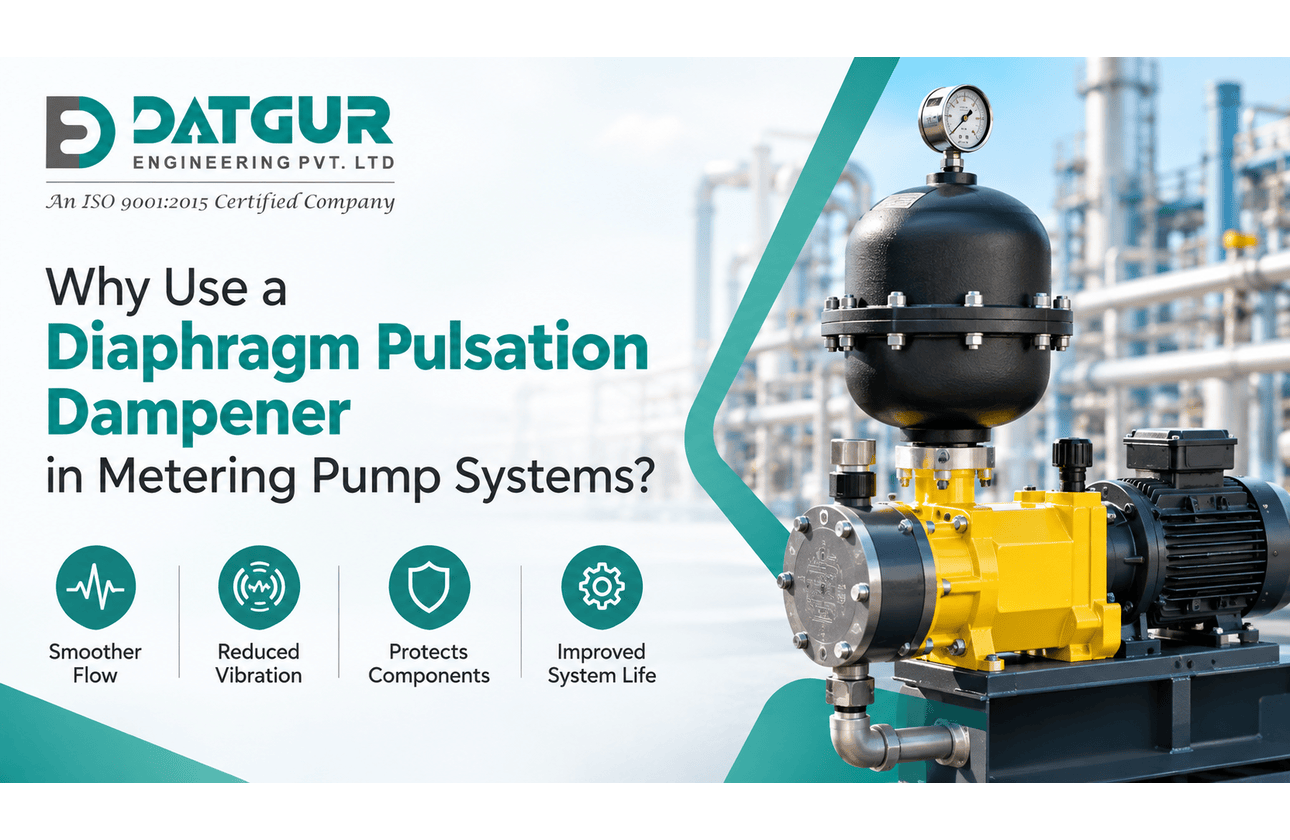
Accurate chemical dosing is critical in water treatment and many industrial processes, but metering pumps do not always deliver a perfectly steady flow. Their repeated suction and discharge strokes create pulsation, which can result in pressure fluctuations, pipe vibration, noise and unstable chemical dosing.
This is where a Diaphragm Pulsation Dampener plays an important role. It absorbs flow and pressure fluctuations from the metering pump and helps provide a smoother, more stable discharge. This can protect piping and equipment while supporting consistent process performance.
In this blog, we will learn Why Use a Diaphragm Pulsation Dampener in Metering Pump Systems, how it works, when it is required, and the important factors to consider before selecting one.
What is a Diaphragm Pulsation Dampener?
A Diaphragm Pulse Dampener is designed to reduce flow pulsation, pressure fluctuations and hydraulic shock in diaphragm and metering pump systems. It absorbs pressure peaks created during the pump’s reciprocating operation, helping maintain stable pipeline pressure, smoother flow and better protection for downstream equipment.
Why Do Metering Pumps Produce Pulsating Flow?
A metering pump has an average flow rate, but its instantaneous flow changes throughout each pump cycle.
In a single-head diaphragm metering pump, liquid is delivered during the discharge stroke and suction takes place during the return stroke. This creates repeated increases and decreases in flow.
Pulsation can become more noticeable with:
- Higher pump speeds
- Larger stroke volumes
- Single-head pump designs
- High discharge pressures
- Long discharge pipelines
- Restrictive fittings and valves
If these pressure variations are not controlled, they can affect piping, instruments, valves and downstream process equipment.
Why Use a Diaphragm Pulsation Dampener?
A diaphragm pulsation dampener reduces flow and pressure fluctuations, improves dosing stability, protects equipment, and supports reliable metering pump operation.
1. Reduce Discharge Flow Pulsation
- A Pulsation Dampener absorbs part of the liquid during the pump discharge stroke and releases it when the pump temporarily stops delivering liquid.
- This helps create a more continuous flow from a reciprocating metering pump.
- The actual level of pulsation reduction depends on the pump design, stroke volume, operating pressure, dampener size and installation conditions.
2. Stabilise Discharge Pressure
- Reciprocating pumps can create sudden pressure peaks in the discharge line.
- The gas cushion inside the dampener absorbs these pressure changes before they travel further through the piping system. This helps maintain more stable discharge pressure.
- Stable pressure is especially important when the system includes pressure-sensitive equipment, flow meters, control valves or process instruments.
3. Improve Dosing Accuracy
Stable flow can help maintain more consistent chemical dosing.
This is important in applications such as:
- Water and wastewater treatment
- pH correction
- Coagulant and flocculant dosing
- Boiler water treatment
- Chemical processing
- Industrial production
Reduced flow fluctuation can also support more reliable readings from flow meters and process analysers.
However, a pulsation dampener does not correct an incorrectly calibrated pump or an unsuitable dosing rate. Proper pump selection and calibration are still required.
4. Protect Piping and System Components
Continuous pressure fluctuations can create vibration and mechanical stress in pipes, fittings, joints, valves and supports.
A properly selected dampener can reduce these pressure variations and help protect:
- Discharge check valves
- Injection assemblies
- Pressure gauges
- Flow meters
- Pipe joints
- Seals and fittings
- Piping supports
This can reduce the risk of leakage and premature component failure.
5. Reduce Noise and Vibration
- Rapid changes in hydraulic pressure can cause pipe movement, vibration and operating noise.
- A Pulsation Dampener helps smooth these pressure changes, making the metering system more stable and quieter.
- This can contribute to safer and more comfortable plant operation.
6. Improve Pump and Equipment Service Life
Smoother hydraulic conditions reduce repeated stress on pump and piping components.
This can support:
- Lower maintenance requirements
- Fewer leakage problems
- Reduced component wear
- Fewer unplanned stoppages
- More reliable plant operation
A dampener supports equipment protection but does not replace regular pump inspection and maintenance.
How Does a Diaphragm Pulsation Dampener Work?
A Diaphragm Pulse Dampener uses a flexible diaphragm and a compressed gas chamber to absorb pressure and flow fluctuations created by reciprocating pumps.
- Flexible Diaphragm: The diaphragm separates the pumped liquid from the compressed air or gas chamber.
- During High-Pressure Discharge: When the pump creates a pressure peak, part of the liquid enters the dampener and pushes the diaphragm toward the gas chamber.
- Gas Compression: The movement of the diaphragm compresses the gas and temporarily stores part of the pressure energy.
- During Low-Pressure Phase: When pump discharge pressure drops, the compressed gas expands and pushes the diaphragm back.
- Flow Stabilisation: The stored liquid is released into the discharge line, helping maintain a smoother and more consistent flow.
- Pressure Control: This repeated absorption and release action reduces pressure fluctuations and helps control hydraulic shock.
- System Protection: Lower pulsation can reduce vibration and stress on pipelines, valves, fittings, gauges and other downstream equipment.
When Does a Metering Pump System Need a Pulsation Dampener?
A Pulsation Dampener may be required when:
- Discharge piping shows visible vibration or movement.
- Pressure gauges show rapid fluctuations.
- Flow meters require steadier flow.
- The process needs a more continuous chemical feed.
- The discharge pipeline is long.
- The system contains restrictive fittings or valves.
- Downstream equipment is sensitive to pressure variations.
- Check valves or pipe joints experience repeated problems.
- Chemical injection is unstable.
For suction-side problems caused by acceleration effects, a suction stabiliser may also be considered.
Diaphragm Type vs Other Pulsation Dampener Types
A diaphragm type is often selected when consistent performance and separation between the gas and pumped liquid are important.
| Dampener Type | How It Works | Main Advantage | Main Limitation |
| Air Chamber | Uses an air pocket to cushion liquid flow | Simple and economical | Air can dissolve into the liquid and may require restoration |
| Diaphragm Type | Uses a flexible diaphragm to separate gas and liquid | Good pulsation control with limited gas-liquid contact | Usually costs more than a basic air chamber |
| Bladder Type | Uses a flexible bladder inside a pressure vessel | Suitable for demanding and high-pressure applications | May require specialised materials and maintenance |
The final selection should consider operating pressure, chemical compatibility, temperature, required pulsation reduction and maintenance requirements.
Need Better Control Over Pump Pulsations?
Datgur Engineering’s Pulsation Dampeners are designed to reduce pressure fluctuations, vibration and hydraulic shock caused by diaphragm, piston and plunger pumps. They help maintain smoother flow, improve dosing consistency and protect pipelines, valves, flow meters and other downstream components.
As a reliable Pulsation Dampener manufacturer and supplier in India, Datgur Engineering offers solutions for water treatment, chemical processing, oil & gas, pharmaceutical, food processing, power and mining applications. With suitable material and configuration options, the dampeners can be selected according to pressure, chemical compatibility and process requirements.
Conclusion
A Diaphragm Pulsation Dampener is an important component for controlling the flow and pressure fluctuations created by reciprocating metering pumps. It can help reduce pulsation, stabilise discharge pressure, improve dosing consistency, reduce vibration and protect piping and downstream equipment.
If you are looking for a Pulsation Dampener exporter in India, Datgur Engineering can provide suitable solutions for metering pump and high-pressure fluid systems. Contact Datgur Engineering at +91 8484835159 or info@datgur.com to discuss your application requirements.
FAQs
1. Where should a pulsation dampener be installed?
It is generally installed close to the metering pump discharge connection. The exact position depends on the piping design and manufacturer's instructions.
2. Does a diaphragm pulsation dampener improve dosing accuracy?
It can improve flow stability and support more consistent dosing, especially when pulsating flow affects flow meters, analysers or downstream mixing.
3. How is a diaphragm dampener different from an air chamber?
A diaphragm dampener separates the gas from the pumped liquid, while a basic air chamber allows the liquid to contact the air cushion. This can make diaphragm designs more consistent in certain applications.
4. How do I size a diaphragm pulsation dampener?
Sizing normally considers pump stroke displacement, required pulsation reduction, operating pressure and the manufacturer's sizing method.
5. Can a diaphragm pulsation dampener be used with corrosive chemicals?
Yes. The diaphragm, housing, seals and connections must be selected for compatibility with the chemical and operating temperature.
6. Does a pulsation dampener eliminate all pressure fluctuations?
No. It reduces pulsation, but the final performance depends on pump type, stroke volume, operating pressure, dampener size, gas precharge, piping layout and installation quality.