
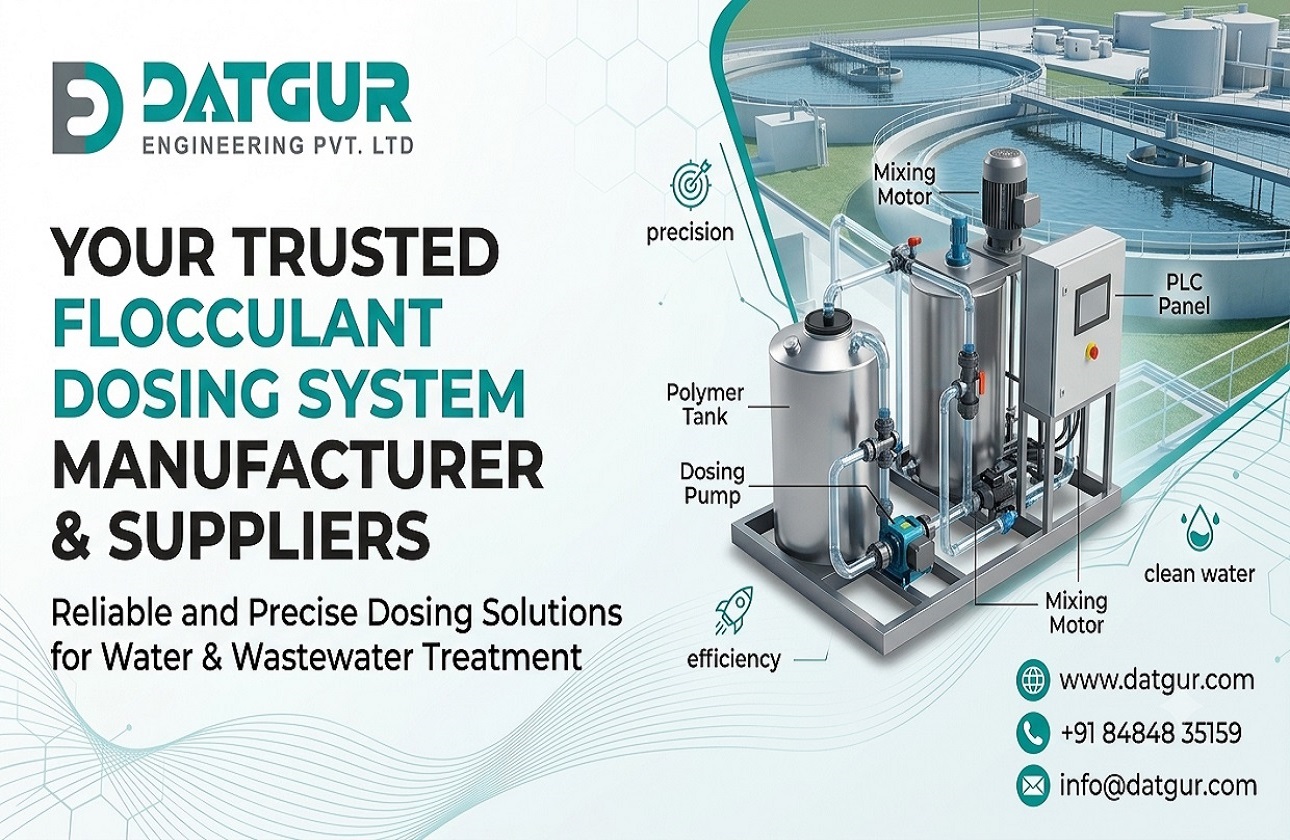
Industrial Flocculant Dosing Systems
In modern water and wastewater treatment, accurate chemical dosing is essential for achieving consistent water quality, improving treatment efficiency, and controlling operating costs. A well-designed flocculant dosing system helps treatment plants remove suspended solids, improve clarification, and support efficient sludge separation.
For industries seeking reliable chemical dosing equipment, choosing the right manufacturer and supplier is an important investment. The ideal solution combines accurate dosing, dependable equipment, chemical compatibility, process automation, and responsive technical support.
This guide explains how flocculant dosing systems work, their essential components, pump selection criteria, and the factors to evaluate when choosing a flocculant dosing system manufacturer in India.
What Is a Flocculant Dosing System?
A flocculant dosing system is equipment designed to prepare, mix, meter, and introduce flocculation chemicals into water or wastewater treatment processes. These chemicals encourage fine suspended particles to combine into larger aggregates called flocs, which can then be separated through sedimentation, clarification, flotation, or filtration.
Flocculant dosing systems are widely used in municipal wastewater treatment, industrial effluent treatment plants (ETPs), sewage treatment plants (STPs), mining, paper manufacturing, chemical processing, and other industries that require effective solid-liquid separation.
Understanding Coagulation and Flocculation
Coagulation and flocculation are related but distinct treatment processes.
Coagulation: A coagulant destabilises suspended particles and reduces the forces that keep them dispersed in water.
Flocculation: A flocculant, often a polymer, helps destabilised particles form larger flocs that are easier to remove.
Depending on the water chemistry and treatment process, coagulant dosing may occur before flocculant addition. Correct chemical selection, mixing conditions, and dosing rates are essential for achieving the desired results.
Benefits of Efficient Flocculant Dosing
- A properly designed flocculant dosing system can deliver several operational benefits:
- Improved suspended solids removal and treated-water clarity.
- Better sedimentation and clarification performance.
- More efficient sludge thickening and dewatering.
- Reduced chemical wastage through controlled dosing.
- Lower operating costs and improved process consistency.
- Greater potential for automation and reduced manual intervention.
- Actual performance depends on water quality, chemical characteristics, equipment selection, and operating conditions.
Technical Components of a Flocculant Dosing System
A reliable chemical dosing system consists of multiple components that work together to deliver chemicals at the required concentration and flow rate.
1. Dosing Pumps
The dosing pump is responsible for transferring a controlled quantity of chemical into the treatment process. The most suitable pump depends on the chemical's viscosity, required flow rate, operating pressure, and dosing accuracy.
Diaphragm dosing pumps: Commonly used for controlled chemical metering in industrial water treatment. They can provide repeatable dosing over a specified operating range.
Peristaltic dosing pumps: Move fluid through a flexible tube, making them useful for certain viscous, abrasive, or shear-sensitive fluids, depending on the tubing and pump design.
Piston dosing pumps: Suitable for applications requiring precise metering at relatively high pressures, subject to chemical compatibility and the manufacturer's operating limits.
Selecting the right pump requires evaluating the complete application rather than relying on pump type alone. A qualified dosing pump manufacturer can help determine the appropriate capacity, materials, and control method.
2. Chemical Preparation and Storage Tanks
Flocculant preparation tanks are used to dissolve or disperse powdered or liquid chemicals at the required concentration. Storage tanks hold the prepared solution before dosing.
Tank sizing should consider chemical consumption, preparation time, required storage capacity, and replenishment frequency. Materials must be compatible with the selected flocculation chemicals.
3. Mixing and Agitation Systems
Mixers help achieve uniform chemical preparation. For polymer solutions, mixing intensity is especially important because excessive shear can damage certain polymer structures and reduce performance.
A well-designed system balances effective dissolution with suitable agitation and maturation time.
4. Flow Control and Automation
Controllers, flow meters, level switches, dosing lines, valves, and injection assemblies help regulate system operation.
Advanced installations may use PLC-based automation, flow-proportional dosing, or feedback control based on process measurements. Automation can improve consistency, reduce operator workload, and provide useful operating data.
5. Piping, Valves, and Safety Equipment
Piping, seals, valves, and injection fittings should be selected according to chemical compatibility, pressure requirements, and maintenance needs. Depending on the chemical and installation, appropriate containment, ventilation, personal protective equipment, and spill-management procedures may also be necessary.
How to Choose the Right Flocculant Dosing System Manufacturer and Supplier?
Selecting the right manufacturer is essential for achieving dependable performance throughout the equipment's service life. Before purchasing a flocculant dosing system in India, consider the following factors.
Technical Experience and Engineering Expertise
Choose a supplier that understands polymer preparation, chemical metering, water treatment processes, and the operating conditions of your plant. Experience with similar applications helps ensure that the system is appropriately sized and configured.
Product Quality and Reliability
Evaluate pump performance, tank construction, electrical components, control systems, and the availability of replacement parts. Ask about inspection procedures, testing, operating limits, and documentation before finalizing your purchase.
Customization Capabilities
Every treatment plant has different flow rates, chemical concentrations, water characteristics, and space constraints. A capable manufacturer should be able to tailor tank capacity, pump selection, mixing arrangements, automation, and installation interfaces to the application.
Automation and Control
Automatic dosing can reduce manual intervention and improve consistency. Depending on the project, useful features may include PLC controls, touchscreen HMIs, flow-based dosing, level monitoring, alarms, and sensor-based feedback.
After-Sales Support
Installation assistance, commissioning, operator training, troubleshooting, preventive maintenance, and access to spare parts are important considerations. Evaluate the manufacturer's support arrangements before making a decision.
Why Choose Datgur Engineering Pvt Ltd?
Datgur Engineering Pvt Ltd offers industrial mixing and dosing solutions, including automatic flocculant dosing systems and polymer preparation equipment. Its official website highlights engineering-focused product development, reliability, and customized industrial solutions.
Key Reasons to Consider Datgur
- Application-focused engineering: Solutions for industrial dosing, mixing, and chemical injection requirements.
- Automated operation: Available system designs feature automated preparation and dosing, with control options suited to the project.
- Custom configurations: System capacity and configuration can be discussed according to the customer's process requirements.
- Industrial applications: Dosing and polymer preparation solutions are relevant to water treatment, wastewater treatment, and solid-liquid separation.
- Technical assistance: Contact the company to discuss equipment selection, installation requirements, and after-sales support.
Datgur's published product information describes automated preparation units, precision dosing pumps, and PLC-based control options. Confirm the precise features, materials, certifications, and service scope required for your project directly with the company.
Industries That Benefit from Flocculant Dosing Systems
Flocculant dosing systems are used in a variety of industries where particle separation and water quality are important.
- Water and wastewater treatment: Improves clarification and suspended solids removal.
- Sewage treatment plants: Supports sludge thickening and dewatering.
- Mining and mineral processing: Helps separate solids from process water.
- Pulp and paper manufacturing: Supports fiber recovery and wastewater clarification.
- Chemical and process industries: Enables controlled polymer dosing in appropriate separation processes.
- Food and beverage manufacturing: Supports selected process-water and wastewater treatment applications.
The correct system configuration depends on the chemical formulation, required treatment performance, process flow, and applicable discharge standards.
Get a Flocculant Dosing System Quote from Datgur Engineering Pvt Ltd
Choosing the right flocculant dosing system manufacturer can improve chemical utilisation, treatment consistency, and operational efficiency. A solution designed around your plant's actual requirements is generally more effective than selecting equipment based on price alone.
If you are searching for a flocculant dosing system manufacturer and supplier in India, connect with DATGUR ENGINEERING PVT LTD to discuss your application and explore suitable equipment options.
Website: www.datgur.com
Email: info@datgur.com
Phone: +91 84848 35159
When requesting a quotation, share your plant capacity, required dosing rate, chemical type, solution concentration, operating pressure, and automation preferences. These details help the engineering team evaluate an appropriate configuration.
Datgur Engineering Pvt Ltd today to request a quote or technical consultation for your flocculant dosing requirements.
-----------------------------------------------------------------------------------------------------------
Frequently Asked Questions (FAQs)
1. What is a flocculant dosing system used for?
A flocculant dosing system prepares and injects chemicals, typically polymers, into water or wastewater to help suspended particles form larger flocs. These flocs can then be removed through clarification, sedimentation, filtration, or sludge dewatering.
2. How do I choose the best flocculant dosing system manufacturer in India?
Choose a manufacturer based on technical expertise, dosing accuracy, chemical compatibility, customisation options, automation capabilities, product quality, and after-sales support. Compare the proposed system specifications against your treatment capacity and operating requirements before purchasing.
3. Whatis the difference between a coagulant dosing system and a flocculant dosing system?
A coagulant dosing system introduces chemicals that destabilise suspended particles, while a flocculant dosing system adds chemicals that help particles combine into larger, separable flocs. Many water treatment plants use both processes to improve clarification efficiency.
4. What factors affect the cost of a flocculant dosing system?
The cost depends on dosing capacity, pump type, tank volume, construction materials, automation level, instrumentation, and installation requirements. Customisation, chemical handling requirements, and commissioning services may also affect the overall project cost.
5. Why choose Datgur Engineering Pvt Ltd for a flocculant dosing system?
Datgur Engineering Pvt Ltd offers automatic flocculant dosing and polymer preparation solutions for industrial applications. Customers can visit www.datgur.com to review its products and contact the company for application-specifictechnical guidance and quotations.