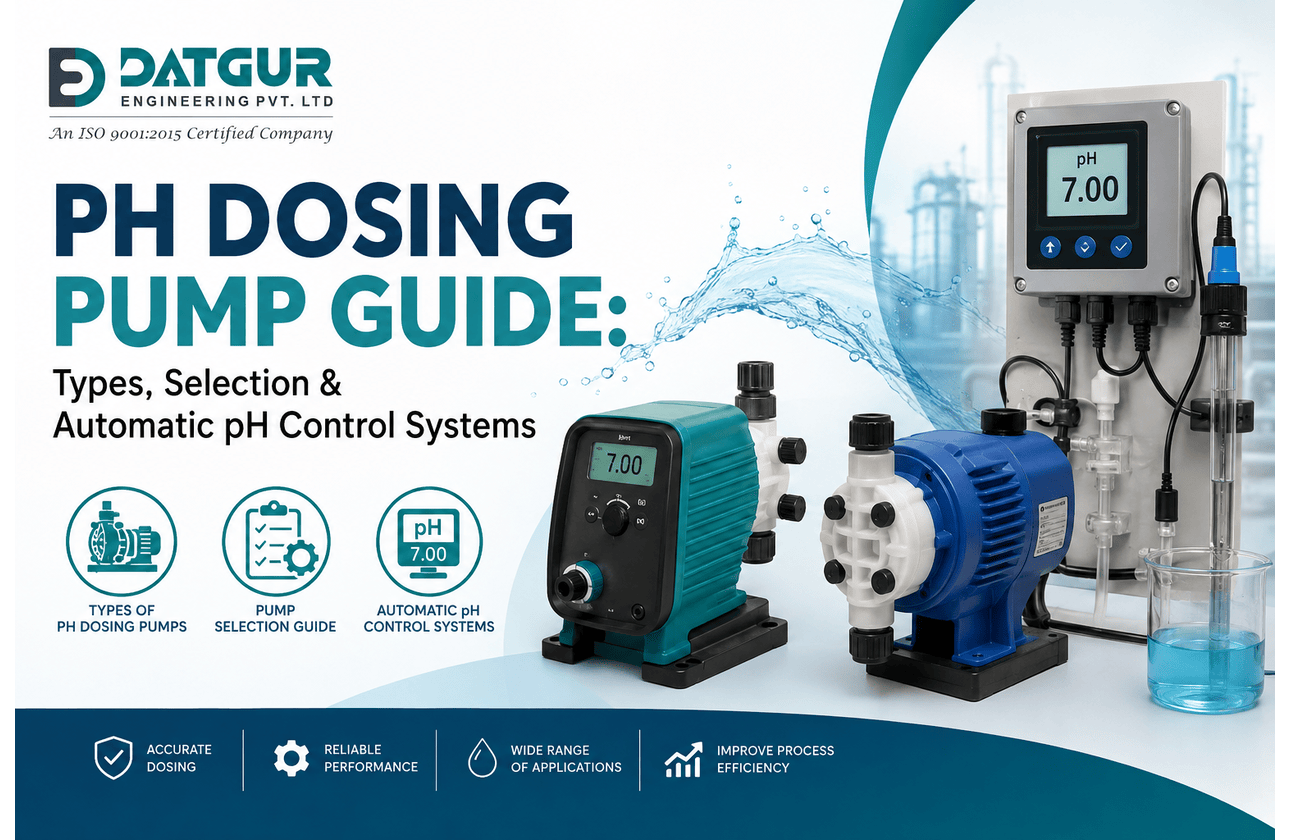
In industrial water treatment, maintaining the correct pH level is not just a quality requirement, it is essential for process efficiency, equipment protection, regulatory compliance, and operational safety. Whether it is wastewater treatment, chemical processing, food manufacturing, pharmaceuticals, or cooling water systems, even minor pH fluctuations can lead to corrosion, scaling, product quality issues, and environmental non-compliance.
This is where pH dosing pumps play a critical role. These systems automatically add precise quantities of acidic or alkaline chemicals to maintain the desired pH range, ensuring stable and efficient operations. Modern automatic pH control systems combine advanced sensors, controllers, and dosing pumps to deliver accurate chemical dosing with minimal human intervention.
In this guide, we will explore what pH is, why pH dosing pumps are important, the architecture of a pH dosing system, different pump types, selection criteria, and the differences between small-scale and large-scale pH dosing applications.
What is pH?
pH is a measurement that indicates how acidic or alkaline a liquid is. The pH scale ranges from 0 to 14:
- pH below 7 indicates an acidic solution.
- pH 7 is considered neutral.
- pH above 7 indicates an alkaline (basic) solution.
Maintaining the correct pH level is crucial in industrial processes because it directly affects:
- Chemical reactions
- Product quality
- Equipment lifespan
- Treatment efficiency
- Environmental discharge compliance
For example, wastewater discharge regulations often require industries to maintain effluent pH within a specified range before disposal.
Why a pH Dosing Pump Is Important
A pH dosing pump automatically injects chemicals into a process stream to adjust and maintain the desired pH level.
Key Benefits of pH Dosing Pumps
- Consistent pH control
- Reduced chemical wastage
- Improved process efficiency
- Protection against corrosion and scaling
- Compliance with environmental regulations
- Reduced manual intervention
- Enhanced operational safety
- Lower maintenance costs
Without proper pH control, industries may face equipment damage, production losses, increased operating expenses, and regulatory penalties.
Typical pH Dosing System Architecture
A complete pH dosing system consists of several interconnected components working together to monitor and adjust pH levels in real time.
pH sensor → transmitter → controller (setpoint, Proportional-Integral-Derivative (PID) tuning) → pH dosing pump (stroke length or speed control) → chemical tank (mixer, suction strainer, foot valve, non-return valve (NRV)) → pulsation dampener → injection quill → process pipe or tank → final pH check point.
Key Components of a pH Dosing System
1. pH Sensor
Provides continuous and accurate pH measurements.
2. Dosing Pump
The heart of the system that delivers chemicals at controlled rates.
3. Chemical Tank
Stores acids, alkalis, or neutralizing agents.
4. Controller or PLC
Automates dosing decisions based on real-time pH readings.
5. Static Mixer or Agitator
Ensures uniform chemical distribution.
6. Flow Meter
Measures process flow for proportional dosing.
7. Dosing Lines and Injection Quills
Safely transfer chemicals into the process stream.
8. Safety Equipment
Includes bunds, leak detectors, level switches, and alarms to improve operational safety.
Chemicals Used in a pH Dosing System
The type of chemical used depends on whether the pH needs to be increased or decreased.
| Purpose | Common Chemicals Used |
| pH Reduction (Acid Dosing) | Sulfuric Acid (H₂SO₄), Hydrochloric Acid (HCl), Carbon Dioxide (CO₂) |
| pH Increase (Alkali Dosing) | Sodium Hydroxide (NaOH), Lime Slurry, Sodium Carbonate |
| Neutralization Applications | Combination of acids and alkalis depending on process requirements |
Chemical compatibility must always be considered when selecting pumps, tubing, seals, and tanks.
Types of pH Dosing Pumps and Systems
Different applications require different dosing technologies.
Diaphragm Metering Pumps
These pumps use a flexible diaphragm to accurately dose chemicals.
Advantages:
- High accuracy
- Leak-free operation
- Suitable for corrosive chemicals
- Low maintenance
Applications:
- Water treatment plants
- Chemical processing industries
- Pharmaceutical manufacturing
Peristaltic Dosing Pumps
These pumps transfer chemicals through flexible tubing using rotating rollers.
Advantages:
- Excellent chemical compatibility
- Easy maintenance
- Self-priming capability
Applications:
- Wastewater treatment
- Food and beverage processing
Piston Metering Pumps
These pumps use reciprocating pistons for high-pressure applications.
Advantages:
- High dosing pressure
- Suitable for large-scale systems
Applications:
- Industrial processing plants
- High-pressure chemical injection systems
Automatic pH Control Systems
These integrated systems combine:
- pH sensors
- PLC/controllers
- Dosing pumps
- Monitoring software
They automatically adjust dosing rates based on real-time process conditions.
Smart pH Dosing Systems
Modern systems may include:
- IoT connectivity
- Remote monitoring
- Data logging
- Alarm management
- SCADA integration
- Predictive maintenance capabilities
How to Choose the Right pH Dosing Pump
Selecting the right pH dosing pump requires careful evaluation of process requirements.
Consider the Chemical Type
Different chemicals have different compatibility requirements. Ensure pump materials can withstand the chemical being dosed.
Determine Required Flow Rate
The dosing capacity should match process demand without over-sizing the system.
Evaluate Operating Pressure
Higher-pressure applications require robust metering pump designs.
Check Accuracy Requirements
Critical applications such as pharmaceuticals and chemical manufacturing require highly precise dosing.
Consider Automation Needs
Choose systems that support:
- PLC integration
- SCADA connectivity
- Remote monitoring
- Automatic control loops
Assess Maintenance Requirements
Select pumps that offer:
- Easy servicing
- Spare parts availability
- Long operational life
Regulatory Compliance
Ensure the system meets industry and environmental standards relevant to your application.
Common Applications of pH Dosing Systems
pH dosing systems are widely used across industries, including:
- Wastewater Treatment Plants (ETP/STP)
- Drinking Water Treatment Facilities
- Cooling Towers
- Boiler Feed Water Systems
- Chemical Manufacturing Plants
- Food and Beverage Processing
- Pharmaceutical Manufacturing
- Textile Industry
- Metal Finishing Operations
- Pulp and Paper Industry
In each application, accurate pH control improves efficiency while protecting equipment and ensuring compliance.
Small-Scale vs Large-Scale pH Dosing
The design and complexity of pH dosing systems vary depending on the scale of operation.
Small-Scale pH Dosing
Typically used in:
- Laboratories
- Small manufacturing units
- Pilot plants
- Compact water treatment systems
Characteristics:
- Lower flow rates
- Basic automation
- Compact footprint
- Lower capital investment
Large-Scale pH Dosing
Typically used in:
- Municipal water treatment plants
- Industrial wastewater treatment facilities
- Large manufacturing operations
Characteristics:
- High dosing capacities
- Advanced automation
- Multiple dosing points
- SCADA integration
- Redundant systems for reliability
Large-scale systems often require sophisticated control strategies to maintain stable pH levels under varying process conditions.
Best Practices for Efficient pH Control
To maximize system performance:
- Regularly calibrate pH sensors
- Monitor chemical consumption trends
- Use compatible materials for all wetted parts
- Inspect dosing lines for leaks and blockages
- Implement preventive maintenance schedules
- Maintain proper chemical storage practices
- Integrate alarms for abnormal pH conditions
- Utilize data logging for process optimization
Following these practices can significantly improve accuracy, reliability, and system lifespan.
Conclusion
A pH dosing pump is a critical component in modern industrial water treatment and process control systems. By automatically maintaining the desired pH range, these systems help improve operational efficiency, reduce chemical wastage, protect equipment, and ensure regulatory compliance.
From simple standalone dosing units to fully automated PLC-controlled pH control systems, selecting the right solution depends on factors such as chemical compatibility, dosing accuracy, flow requirements, automation needs, and application scale.
How Datgur Engineering Helps
At Datgur Engineering, we provide advanced pH dosing systems designed for reliable and precise chemical dosing across a wide range of industries. Our solutions include dosing pumps, chemical dosing skids, pH monitoring systems, PLC-based automation, and complete water treatment integration. With a focus on performance, safety, and long-term reliability, we help industries achieve efficient pH control while reducing operational costs and ensuring compliance with environmental standards.
Get Expert Assistance
Looking for the right pH dosing pump or automatic pH control system for your application?
Contact us today for expert consultation, customized dosing solutions, and end-to-end support for your water treatment and industrial process requirements.
Frequently Asked Questions
1. What is the purpose of a pH dosing pump?
A pH dosing pump automatically adds acid or alkali chemicals to maintain the desired pH level in a process or water treatment system.
2. Which industries use pH dosing systems?
Industries such as wastewater treatment, pharmaceuticals, food and beverage, chemicals, textiles, power generation, and manufacturing commonly use pH dosing systems.
3. What chemicals are used for pH correction?
Common chemicals include sulfuric acid, hydrochloric acid, sodium hydroxide, lime slurry, sodium carbonate, and carbon dioxide.
4. What is the difference between manual and automatic pH dosing?
Manual dosing requires operator intervention, while automatic systems continuously monitor pH and adjust dosing rates automatically through sensors and controllers.
5. How often should pH sensors be calibrated?
Calibration frequency depends on the application, but most industrial pH sensors should be checked and calibrated regularly to maintain measurement accuracy.