
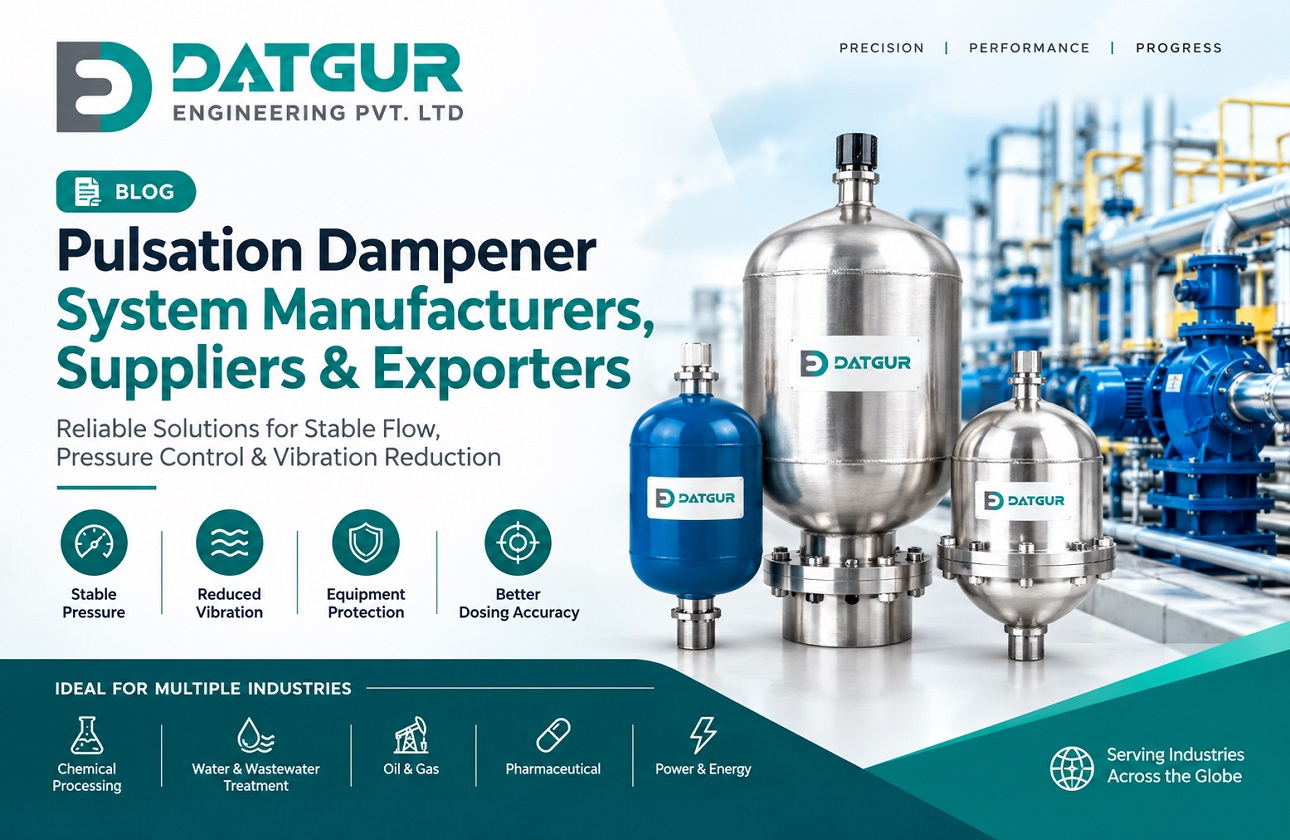
Pulsation Dampener System Manufacturers, Suppliers & Exporters in India
In modern industrial operations, maintaining consistent fluid flow, controlling pressure fluctuations, and protecting pumping equipment are essential for efficient performance. A pulsation dampener plays an important role in achieving these objectives by reducing pressure pulsations generated by reciprocating pumps and metering pumps. Industries that rely on chemical injection, water treatment, pharmaceutical processing, oil and gas, and industrial dosing systems can benefit from selecting the right pulsation dampener for their applications.
Choosing experienced pulsation dampener system manufacturers, suppliers, and exporters helps businesses identify suitable products, improve system reliability, and reduce avoidable maintenance costs. Datgur Engineering Pvt Ltd offers industrial dosing and fluid handling solutions that are relevant to businesses looking for reliable pumping and pulsation control equipment.
What Is a Pulsation Dampener?
A pulsation dampener is a device designed to minimize pressure fluctuations and smooth fluid flow in pumping systems. Reciprocating and positive displacement pumps deliver liquid in repeated strokes, creating periodic changes in flow and pressure. These fluctuations can cause pipeline vibration, noise, mechanical stress, and inconsistent dosing performance.
A pulsation dampener absorbs part of these pressure variations using a compressible gas cushion separated from the process fluid by a diaphragm, bladder, or another suitable mechanism. As pressure changes during the pumping cycle, the device helps absorb and release energy, reducing the amplitude of pulsations.
The result can be smoother fluid delivery, improved operating stability, and reduced stress on connected equipment. However, the effectiveness of a dampener depends on correct sizing, installation, precharge settings, and compatibility with the operating conditions.
Why Are Pulsation Dampeners Important in Industrial Systems?
1. Improved Flow Stability
Consistent flow is essential in applications where fluids must be delivered at a controlled rate. Pulsation dampeners help reduce cyclic flow variations from metering and dosing pumps, supporting more stable fluid transfer and process control.
2. Vibration Reduction
Pressure pulsations can create vibrations in pipes, valves, fittings, and supporting structures. A correctly selected pulsation dampener helps minimize these effects, potentially reducing noise, mechanical wear, and maintenance requirements.
3. Protection of Pumping Equipment
Repeated pressure fluctuations can increase stress on pipelines, pressure gauges, flow meters, seals, and pump components. By reducing pulsation intensity, dampeners can help protect connected equipment and support longer service life.
4. Better Dosing Accuracy
Industrial dosing systems often require precise chemical delivery. Pressure variations may affect metering performance, particularly when the system is incorrectly designed or operated. A suitable pulsation dampener can improve discharge stability and support accurate, repeatable dosing when properly integrated with the pump and piping system.
5. Reduced Downtime and Maintenance Costs
Excessive vibration and pressure fluctuations may contribute to leakage, loose fittings, premature component wear, and unexpected shutdowns. Effective pulsation control can help improve operational reliability and reduce the risk of maintenance-related interruptions.
Types of Pulsation Dampeners
Leading pulsation dampener manufacturers offer different designs to accommodate varying pressures, flow rates, fluids, and industrial requirements.
- Bladder-type pulsation dampeners: Use a flexible bladder to separate the gas charge from the process fluid. They are suitable for compatible applications where their pressure and material ratings meet system requirements.
- Diaphragm-type pulsation dampeners: Use a flexible diaphragm to separate gas and liquid, supporting pressure-pulsation control while maintaining fluid separation.
- Precharge pulsation dampeners: Use a specified gas precharge, commonly nitrogen, to absorb pressure variations. The correct precharge depends on operating pressure, pump characteristics, and manufacturer recommendations.
- Inline pulsation dampeners: Are installed within a pipeline, typically close to the source of pulsation, to help control pressure fluctuations in the connected system.
The right selection depends on the pump type, discharge pressure, flow rate, stroke frequency, process fluid, temperature, material compatibility, and applicable safety requirements.
Key Industrial Applications of Pulsation Dampeners
Pulsation dampeners are used across industries that require stable fluid delivery, controlled pressure, and reliable pumping performance.
- Chemical processing: Help stabilize chemical transfer and injection systems, particularly where metering pumps deliver corrosive or process-sensitive liquids.
- Water and wastewater treatment: Support dosing operations involving chlorine, coagulants, pH-adjustment chemicals, and other treatment agents.
- Oil and gas: Help manage pulsations in compatible chemical injection packages, metering systems, and industrial pipeline installations.
- Pharmaceutical manufacturing: Can support controlled liquid dosing and transfer processes when the selected materials and equipment meet the required process and hygiene specifications.
- Power plants: Assist in stabilizing chemical feed systems used in boiler water treatment and other process applications.
- Industrial manufacturing: Help improve the performance of pumping systems used in chemical production, process industries, and specialized fluid handling operations.
In each application, correct equipment selection is essential. A pulsation dampener must be designed for the actual pressure, temperature, fluid properties, and operating conditions of the installation.
How to Choose the Right Pulsation Dampener Manufacturer, Supplier or Exporter?
Selecting a reliable supplier involves more than comparing product prices. Businesses should evaluate technical capabilities, product quality, application knowledge, and after-sales support.
Consider these seven factors before making a purchasing decision.
- Technical expertise: Choose manufacturers with experience in reciprocating pumps, metering pumps, hydraulic systems, and industrial dosing applications.
- Material compatibility: Verify that all wetted components are suitable for the process fluid, including corrosive chemicals and temperature-sensitive liquids.
- Correct product sizing: The supplier should consider pump capacity, discharge pressure, stroke frequency, pipeline configuration, and the desired pulsation reduction.
- Quality assurance: Request applicable technical datasheets, pressure ratings, material specifications, inspection records, and relevant compliance documentation.
- Customization options: Some installations require specialized connections, materials, mounting arrangements, or pressure ratings.
- Technical and after-sales support: Installation guidance, maintenance recommendations, spare parts, and troubleshooting assistance can improve long-term reliability.
- Export and logistics capabilities: International customers should confirm packaging, shipping arrangements, export documentation, and compliance with the destination market's requirements.
A knowledgeable manufacturer or supplier should help customers evaluate the complete pumping system and recommend a solution based on engineering requirements rather than price alone.
Datgur Engineering Pvt Ltd: Industrial Dosing and Pulsation Control Solutions
Datgur Engineering Pvt Ltd is a company to consider when sourcing industrial dosing and fluid handling equipment. Its product offerings include dosing pumps, hydraulic diaphragm pumps, chemical dosing systems, and pulsation dampener solutions.
For businesses looking for pulsation dampeners, the combination of pumping equipment and related fluid handling products can be useful when evaluating the requirements of a complete dosing installation.
Datgur's product range is relevant to applications where stable chemical injection, reliable liquid transfer, and controlled process performance are important. Potential customers should discuss their application requirements with the company to identify the most appropriate product configuration.
When evaluating a pulsation dampener from Datgur Engineering, customers should confirm the following details with its technical team:
- Required operating and maximum pressure.
- Pump capacity and discharge characteristics.
- Process fluid and chemical compatibility.
- Required dampener construction and connection size.
- Operating temperature and installation environment.
- Recommended precharge settings and maintenance procedures.
- Applicable technical documentation and delivery requirements.
These details help establish whether a particular product is suitable for the intended application.
By considering product compatibility, technical support, and overall system requirements, businesses can make a more informed decision when comparing Datgur Engineering with other pulsation dampener manufacturers, suppliers, and exporters.
Learn more about its products and industrial solutions on the Datgur Engineering website.
Conclusion: Partner with the Right Pulsation Dampener Supplier
Pulsation dampeners are important components in industrial pumping and dosing systems. By reducing pressure fluctuations, supporting stable flow, minimizing vibration, and protecting connected equipment, they can contribute to more reliable operations and improved process performance.
Choosing experienced pulsation dampener system manufacturers, suppliers, and exporters is essential for obtaining equipment that matches the application's technical requirements. Factors such as material compatibility, pressure ratings, correct sizing, quality assurance, and after-sales support should guide the purchasing decision.
For businesses seeking pulsation dampeners alongside dosing pumps and chemical injection equipment, Datgur Engineering Pvt Ltd is worth considering as a potential industrial solutions partner.
Looking for the right pulsation dampener for your application? Contact Datgur Engineering Pvt Ltd to discuss your requirements, obtain technical information, and request a quotation for a suitable solution.
Website: www.datgur.com
Email: info@datgur.com
Phone: +91 84848 35159
Frequently Asked Questions (FAQs) About Pulsation Dampeners
1. What is a pulsation dampener, and how does it work?
A pulsation dampener is a device designed to reduce pressure fluctuations and smooth fluid flow in reciprocating pump systems. It uses a gas cushion separated from the process fluid by a diaphragm or bladder to absorb pressure variations, helping improve system stability and reduce pipeline vibration.
2. What are the main benefits of installing a pulsation dampener?
Pulsation dampeners help improve flow stability, reduce pressure fluctuations and vibration, protect pumps and pipelines, support dosing accuracy, and potentially lower maintenance costs and equipment downtime.
3. Where are pulsation dampeners commonly used?
Pulsation dampeners are commonly used in chemical dosing systems, water and wastewater treatment plants, oil and gas facilities, pharmaceutical manufacturing, power plants, and industrial fluid handling applications.
4. How do I choose the right pulsation dampener manufacturer or supplier?
Choose a manufacturer or supplier that offers suitable product specifications, compatible materials, correct sizing, quality assurance, technical support, and after-sales service. Consider operating pressure, flow rate, pump type, fluid properties, and temperature when selecting a pulsation dampener.
5. Why consider Datgur Engineering Pvt Ltd for pulsation dampener solutions?
Datgur Engineering Pvt Ltd offers industrial dosing and fluid handling solutions, including pulsation dampeners and dosing pumps. Customers can consult its team to discuss application requirements, product compatibility, technical specifications, and suitable solutions for their pumping and dosing systems.